-->
skip to main | skip to sidebar

Sunday, 17 April 2022

New Song, Same Old Lyrics

As part of a general online overhaul, this blog is moving. Whereas up to now it's been hosted by Blogger - many thanks, Blogger, for this accessible and user-friendly option for the technically challenged - from here on it will be integrated into the website at stephengallagher.com. At the time of writing the site's still a work in progress, with a lot of placeholders.

But the blog's up and running and the backlog of material has been ported across. To respect any old bookmarks or searches I'll leave this version up at this location to sail onward like a ghost ship, crewless and uncaptained but with its cargo intact.

Okay, so in such circumstances a cargo can get a bit mouldy, but let's not push the comparison too far.

Tuesday, 22 March 2022

Comparative Anatomy: for preorder

With an introduction by Stephen Volk

“Magic always stops at midnight,” says the doomed narrator in the title story of Stephen Gallagher’s career-spanning collection, Comparative Anatomy, but while that may be true, the reader will find no end to the magic in these thirty astonishing tales by one of Britain’s most distinguished writers.

From the inimitable postwar melancholy of a forlorn ghost bound to the house in which it died in “Twisted Hazel,” and a common man’s misguided attempt to temper grief in “Shepherds’ Business,” to the unsettling demands of an overbearing family desperate to reap the rewards of vicarious fame in “Little Dead Girl Singing” and the collision of disparate personalities among wicked children and bizarre religion in “The Butterfly Garden,” Comparative Anatomy is as much a meditation on what it means to be alive as it is an exploration into what may await us when we die. 

Herein you’ll find stories that explore the very nature of ghosts and how often it is us, and not those we’ve lost, who do the haunting, as the lines blur between the paranormal and the pathological, and all manner of characters from time travelers to clairvoyants, priests to serial killers, and thieves to ventriloquists, find their souls laid bare by spectral encounters and the sinister desires of man’s own fractured psyche to know what comes next. 

Comparative Anatomy includes two original tales, a novelette, “The Backtrack,” and a short story, “Live from the Morgue,” written especially for a collection by an author at the height of his power as one of the premier dark fantasists of his generation. 

Limited: 1000 signed numbered hardcover copies. Available for preorder.

Special Offer: Those who preorder Comparative Anatomy from SubPress will receive an ebook of the original novelette, "Hounded," about which the author writes:

A big old house with a private forest; what better place for Charlie to play host to his godson, their partner, and two dogs in their time of need? But Charlie should beware. The rescued know that security, once found, is not to be given up lightly.


 To preorder from Subterranean Press, click here

Saturday, 19 March 2022

Well, this looks rather fine


Thursday, 17 March 2022

Everything But The Doc

My spot on the guest list at Gallifrey One came about through my association with Cutaway Comics, a sprung-from-lockdown publishing house featuring creator-owned material in a Doctor Who splinter universe; characters, monsters, villains and others all licensed from their individual rights holders or, in some cases, their estates. I was there with publisher Gareth Kavanagh, writer/editor Ian Winterton, and artist Martin Geraghty as part of the launch of Cutaway's Gods and Monsters megaproject.

Gods and Monsters comprises a set of one-shot comics based around individual characters followed by a six-part limited series. The series draws all of them together in a single narrative. It's been supported by a crowdfunding campaign that was launched at the convention and which met its target within twelve hours. By the time it ended, the Kickstarter was funded almost four times over with numerous stretch goals triggered.

(If you missed out, the one-shots and series will be available through the usual retail outlets.)

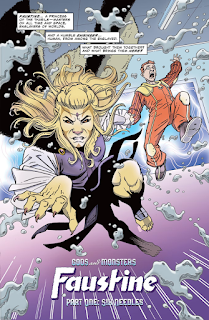
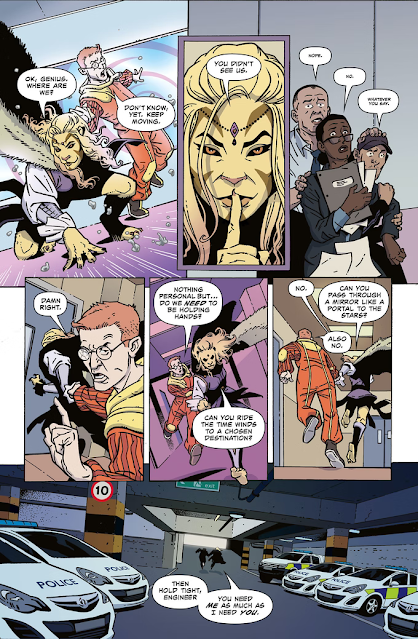
It's a vast project but the part I tend to bang on about is the first of the one-shots, Faustine, because that's the one I wrote. Faustine herself is a new character but the backdrop to this two-parter - if a one-shot can be a two-parter - is the human slave uprising that played a significant role in the Tom Baker Season 18 story Warriors' Gate.

The story's in the late stages of production now with art by Martin Geraghty, colours by Andrew Orton, design and lettering by Colin Brockhurst. I've watched it all coming together and it's looking great.

Meanwhile, at Gallifrey, the Cutaway stand sold out all of its stock of current titles. We managed to escape the hotel for a few hours either side of the weekend, first navigating the LA transport system for a visit to Santa Monica Pier and a walk down to Venice Beach, and later with a rental car for a whistlestop tour where I got to show some favourite spots of mine; the view from Mulholland Drive, the House of Secrets comic book store, the '60s TV Batcave in Bronson Canyon, the Music Box steps, the Bradbury Building as featured in Blade Runner and Harlan Ellison's Outer Limits episode Demon With A Glass Hand (closed to the public due to Covid restrictions, but I could offer a squint through the windows).

Faustine will be available soon and Gods and Monsters will follow. Watch this space for more.

Sunday, 13 March 2022

Gallifrey One 2022

It's now more than two weeks since my return from the all-vaxxed, all-masked 32nd Gallifrey One, the big annual Doctor Who convention in Los Angeles. They had to skip last year because of Covid and capped this year's attendance at 2,600 to reduced crowding. After two transatlantic flights and a weekend spent mingling with more people than I've been close to in the past 2 years, I'm still testing negative. The Con itself was one of the most enjoyable I've attended, down mainly to the calm efficiency of the organisation and the relentless good spirits of the attendees.

There were no noticeable problems over mask compliance and the requirement for proof of vaccination or infection-and-recovery meant that dropping the masks for food and drink felt like a low-risk move, allowing for sociable evenings in the bar. Guests onstage could choose whether to remove masks, which most of us did. Microphones and seats were wiped down between panels. There was no masquerade but cosplay was in evidence throughout. I lost count of the Jodie Whittakers (of all ages) but it was the three identical David Tennants that messed with my head.


The general endorsement of the measures has to be qualified by the fact that those with objections stayed away, while the organisers could point to city ordinances to back up Convention rules. Despite that I understand that they took some online abuse. No one present considered this a 'new normal', but a transitional stage on the way back to it. Last year I was writer GoH at the all-online World Fantasy Convention, where the move online was one of the first, bold steps in keeping the flame alight. We didn't kid ourselves that we could replicate the presence and conviviality of the live event, but the Con committee pulled off a remarkable feat.


I will say that Zoom's brought a permanent new element into fandom. My local SF group, well into its fourth decade, moved entirely online in the first weeks of lockdown and we've been meeting virtually twice a week ever since. The big advantage; several of those who've moved away (and in a couple of cases left the country) get to join in again. When we go back to something more approaching normal we plan to have one live pub meet and one online, to keep everyone onboard.

Tuesday, 1 March 2022

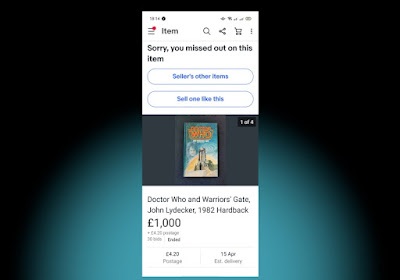
Auction for Ukraine: Warriors' Gate in rare hardcover

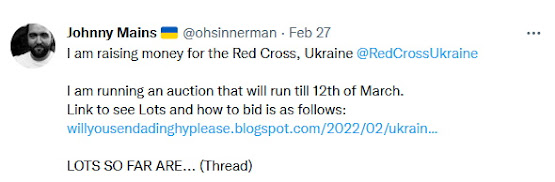
Johnny Mains is running an auction of books, scripts, and other genre-related goodies, many of them donated or signed by the creators, to raise funds for Red Cross humanitarian aid in Ukraine.


That's a screenshot but you can click here for the actual link.

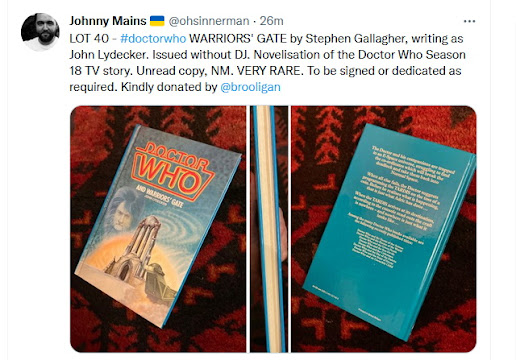
 Among the lots on offer is this:

One of a short run of hardcovers produced for library issue, this copy's been in shrinkwrap for 30 years so condition's as good as it gets. You're unlikely ever to see an example that isn't ex-library. It's from my personal archive and I wasn't intending to part with it, but these are exceptional times.

Johnny's taking bids via the comments section of his blog, so without the involvement of eBay or any other auction house 100% of the money goes to the Red Cross. The winning bidder on March 12th makes the payment to Red Cross Ukraine and on proof of receipt the item's donor will send it directly to the winner.

Johnny originally specified UK bidders only, but is making exceptions for those willing to bear the cost of overseas postage. 

If you want to put in a bid on this lot, Lot 40, go for it. And look at the other lots as well, there's some great stuff in there. Otherwise please consider passing this information along, particularly to any Doctor Who fan, newsgroup, blog, website or other outlet you think may care to know about it. We have until March 12th. There was considerable interest when a clean copy was offered on eBay last April; without that platform we can't hope to achieve the same reach, but we can try.

UPDATE: A successful fundraiser. Thanks to Johnny, and to all who bid.

Thursday, 27 January 2022

Stephen Couper and the Old Stuff

Stephen who, you may ask?

Well, there's a story.

This covers shot was posted on social media by novelist, games lead writer and tie-in king Steven Savile. Steve is a friend and, Gawd bless 'im, also a completist collector of my stuff. These pseudonymous '80s paperbacks filled a last gap on the shelf, he reckons. They're an example of a form I think I may have pioneered, the Two-Book Trilogy.

To explain. My first pro sale was a radio serial titled The Last Rose of Summer. Made for peanuts with love and joy, it was the spawn of a bunch of TV and radio colleagues and it played at strange hours on commercial radio stations throughout the land. Our timing was good. It was science fiction, and '77 was the summer of Star Wars. I was 23.

The first book sale came right after, a spinoff in the form of a novelisation of the serial scripts. The six half-hours offered a handy mass of foundation material for 70,000 or so words.  It wasn't just a matter of putting in the he said/she saids, although I've seen many a book-of-the-film that did little more. 

Instead it was a pretty steep learning curve. What I picked up in a short time was the essential difference between script and prose. In a drama we infer a character's inner life from all the externals; what they say, what they do, what we're shown. In prose fiction we automatically put ourselves inside a character's mind and experience the story world through their perceptions. Outside looking in, inside looking out. Which is why point of view matters.

The radio serial was followed by two more. The same was intended for the books but it emerged that, Hitchhiker's Guide notwithstanding, the radio novelisation was too niche a genre to be commercial. The second book was written and there was even a cover designed, but publication was cancelled and the contract was paid off.

Good SF never dates, but I fear this wasn't that. I'd channeled the central trope from 1984 along with a 1960s schoolboy understanding of computer science and I hadn't yet learned to write women. It did have something, though. If I dip into it now, alongside the wince-making stuff I like to think I can see some of the native aptitude that others sensed and were willing to back.

By then my agent had placed Chimera with Sphere, who sold on the hardback rights to Michael Joseph. Then Michael Joseph pulled out on the belated realisation that they'd get no share of the paperback revenue, so instead Sphere offered to reprint Last Rose and the unpublished SF titles... but on condition that I used a pseudonym, to avoid crossover with the campaign they were planning for Chimera. Which is how Stephen Couper came into the world.

Rather than reprint, I rewrote. Names, incidents, worldbuilding... I can't give you details, it's mists-of-time stuff now. So The Last Rose of Summer became Dying of Paradise and Hunters' Moon became The Ice Belt and The Babylon Run... well, with history repeating itself, The Babylon Run was written but didn't make it. 

Hence, the two-book trilogy.

I look back with mixed feelings. I meant to improve on my tyro efforts, but it feels more like I just mucked about with the material. And while Last Rose may be the purer version, The Ice Belt no longer connects to it.

People remember the original serials, which is nice. They're easy enough to find online. I'm sometimes asked if I'm thinking of reissuing the novels and I tend to dodge the question. It's... messy.

Also, with the exception of The Babylon Run I don't have the books in digital form. I could scan them, but Last Rose had some inept copy-edits that I was never given the chance to correct, and I can't say for certain whether the original manuscript is still intact or got chopped about to make Paradise. The papers are all in my old university's collection at the Hull City Archive. I make the trip every now and again if there's something I need to check... but is this really that kind of need? It's not like we're talking about a Shakespeare First Folio.

And if Steve Savile's example is anything to go buy, if you're really interested you can pick up nice old copies for around three quid a pop.

I said there was a story. I never said it was a great one.

Friday, 14 January 2022

News, Unexpected


 So look what popped up in my Twitter timeline yesterday, and I'm grateful to Charles for passing it on; The Governess, a chapbook put together as a labour-of-love lockdown project, has received this recognition from the Arthur Conan Doyle Society. The announcement came in its inaugural Doylean Honours Awards ceremony, streamed live from Manhattan's Mysterious Bookshop.

The physical form of the book—the layout, the page settings, the font choices—is based on a first edition copy of The Poison Belt that I picked up for not much money just a week or so before Covid hit. 

The W S Stacey and F S King illustrations, long out of copyright, are photographed from old bound magazines on my shelves. With the story already written, I combed through their pages in search of images that worked with the text. They're all from different, unrelated pieces. To the spirit of the other artist whose name wasn't given, I can only offer appreciation and an apology.

Mention Conan Doyle to most people and their thoughts will go straight to Holmes, but for me it was always The Lost World that fired the imagination. I've written elsewhere of the part it played in my Murder Rooms TV movie (covering an episode in the life of the young Dr Doyle that would inspire the later fantasy) and how it shaped some of the thinking behind The Bedlam Detective, the second of my three novels about the Special Investigator to the Lord Chancellor's Visitor in Lunacy.

It was in The Bedlam Detective that I had something of a dry run for The Governess. It was in the form of a first-person chapter written in the Edwardian voice of Sir Owain Lancaster, leader and almost lone survivor of an Amazon expedition with a disastrous outcome.

The Challenger short story is narrated by The Lost World's Edward Malone, and features the Professor in his later role as a spiritual investigator. Doyle, as we know, was fully on board with the Spiritualist movement. I'm not, but here as in my earlier novella In Gethsemane I find it a potent source of metaphor and human drama.

Both of those pieces, I should add, will be included later this year in Comparative Anatomy: The Best of Stephen Gallagher, my mega short story colection from Subterranean Press. That will also include some new fiction.

But for now, you can pick up the chapbook here. Even if it's only for the pictures.

The Governess

The Bedlam Detective


Thursday, 6 January 2022

FAUSTINE

New for 2022 from Cutaway Comics

 Kickstarter launching soon

UPDATE: Kickstarter now live ending Friday, March 11


Saturday, 4 December 2021

Winter Tales

Look out of the window. It's lousy out there, right? Stay warm, stay safe, stay dry, and here's something to take you away. Now online and live: five stories, read by their authors, for those inhospitable winter evenings.

Winter Tales: Click Here

https://www.youtube.com/watch?v=IPLdqEf13Io


Tuesday, 23 November 2021

No Time To Die: My Spoilerific Review

Retro Bond art by Sean Longmore

Me and Bond go way back, back to when I saw Dr No with my Dad in Monton's Princes Cinema on its first run. Then From Russia, and on. We went to each new movie until I got a girlfriend to go with (something with a generational resonance that passed over my head at the time). 

I'm not obsessive, but you can say I'm invested. I mean, I got into the press show for Star Wars, but the subsequent spinning-off and franchising have diluted my affection to a homeopathic level. Meanwhile each new Bond title, each new casting, has been a standalone event. I can more or less map my life against them, so I'm more aware than most of how each phase of the series reflects its era.

I can't remember when I last looked forward to a release with as much anticipation, and I wanted to go in with perceptions unclouded. If you feel the same but you're holding out for the streaming price to fall, or you've the Blu Ray on preorder, skip away and come back when you're done. I expect I'll still be around.

Craig's been terrific in the role, I think. I've written elsewhere of how he crossed my radar on an earlier, unmade project, so I was sold from the start of his run. The essence of Bond is that he's toxic masculinity weaponised for the common good. Team Craig's achievement is that his Bond is aware of the fact, and isn't at peace with it. The humane approach doesn't sit well with some, who are quick to call it 'woke'. But there was a time when a two-fisted lothario could be promoted as something admirable, and that time is not now.

So what did I think of this latest? And, for Craig, his last?

Well...

Let me say that I loved what they set out to do, and where that was aimed to take us. But not unconditionally. Not the way I loved Skyfall, where I could disregard its preposterous foundation for the joy it unlocked.

As a writer I guess I have to focus on the script to work out why. Many people, quite a few critics included, see script only in terms of dialogue. But scripts are nearly all structure. What happens, in what order, and where does it land. Structure first, then dialogue as necessary. 

Purvis and Wade have been the largely unsung heroes of the series since The World is Not Enough, often overshadowed by the addition of a more celebrated figure to work over their material. I've no inside line on how well that works out, but I do occasionally think it shows.

The issues I had with No Time To Die were less about intent, more about narrative clarity. I didn't buy Bond's go-to blaming of Madeleine when literally any of his enemies could have foreseen a visit to Vesper's tomb, yet his rejection is fundamental to everything that follows; the journey, the discovery, the regret, the redemption (it's a point that could have been so easily sorted with a misreading of some secretive behaviour that pays off later as the pregnancy reveal). Blofeld and Spectre made for a diversion that easily exceeded their story value. The actual villain's plan and the nature of his weapon were so unclear that I reckon a lot of people maybe didn't get why Bond had no choice beyond a selfless sacrifice at the end.

(and I felt I had a better chance than most at grasping the implications of a DNA-targeting disease, having used the same device in a TV episode in 1995. UPDATE: I've given NTTD a second viewing now and I'm still no wiser as to who are the millions that Malek's Lyutsifer Safin plans to kill, or why)

Don't want to say I didn't like it. I'm too onside for that. But kind of wish I'd liked it more. 

Japanese release fan poster by Sean Longmore
Where they'll go next I don't know, but I sat next to Barbara Broccoli at a screenwriters' lunch once and I know she's smart. Too smart to look me up again, apparently, but what can you do. If you stay around until the end of the credits the final card reads, as ever, JAMES BOND WILL RETURN. Some people are assuming this is an indication that he's somehow survived the blast, or that they're now committed to continuing with Lashana Lynch's redesignated 007.

What I'd say it points to is a franchise reboot. New deck, new game. So what if he died in this one? There's more than one film about Jesus. More than one staging where Hamlet always gets it at the end.

The Bond phenomenon involves an unusual pact between makers and audience. We all know there have been other Bonds and other movies. Both sides enjoy nods to them while accepting that this one's the present reality, a self-contained iteration of the character. Casino Royale started with Bond earning double-0 status with his very first sanctioned killing. So that was a debut, not a continuation. Yet in Skyfall we all lit up with delight on the reveal of the Goldfinger Aston Martin, machine guns at the ready.

I regret that they didn't put Moneypenny back in the field. Naomie Harris shone in Skyfall and I've been itching to see her used more in every outing since.

But it's too late for that now. New deck, new game. 

Retro Bond art by Sean Longmore

Thursday, 30 September 2021

Kicking Off The Sixties

This posting from Network's Twitter feed didn't so much trigger a memory as confirm one. Somewhere in the back of my mind lurks the vivid image of a life-sized Supercar, complete with life-sized test pilot Mike Mercury, revealed at the centre of the revolve in the end credits of Sunday Night at the London Palladium. It's been in my head pretty much for ever.

Ok, some unpacking needed here for those who might be gazing at those words and wondering WTF is he even saying. Chances are that you've heard of Supercar because it's a part of the Gerry Anderson universe which, thanks to repeats and remakes but mainly by having made itself a permanent place in British culture, continues to have a life beyond the nostalgia market.

Supercar wasn't the first Anderson show and these days may not be one of the best-known; being shot on monochrome stock and with a more juvenile angle, it hasn't lent itself to revivals and reruns like brand leaders Thunderbirds and Captain Scarlet. But for me it was the one whose timing had the greatest impact.

Blew my tiny mind, as I declared in an online response.

There was a cast of characters - a test pilot, a couple of scientists, a boy, a monkey, and a couple of idiot villains - but the car was the star; taking the futuristic features of the American gas guzzler and streamlining them into something with a genuine aesthetic, it was the ultimate go-anywhere, do-anything toy.

(Though the boy was voiced by Sylvia Anderson, there was no regular female cast member. There's a dissertation waiting to be written on the evolution of female characters in children's TV from sole tomboy gang member to bill-topping protagonist... unless someone's already covered it, of course.) 

This ultimate toy with its puppet cast featured in a series of half-hour action stories. The first season was mostly written by brothers Hugh and Martin Woodhouse, squeezing in the odd nugget of real science trivia wherever they could; for my money, nerd culture as we know it started right there. Martin Woodhouse also contributed episodes for the Patrick MacNee/Honor Blackman Avengers and wrote a series of highly readable science-and-espionage thrillers for the adult market; I tracked them all down as part of the background research for Eleventh Hour, and wished I'd discovered them earlier.

Sunday Night at the London Palladium was a Variety show broadcast live from the eponymous venue in the West End. The bill featured singers, comedians, jugglers, 'speciality' acts, a mini-gameshow, and a regular troupe of dancers called The Tiller Girls ("I know why they're called The Tiller Girls," quipped guest host Roger Moore one week in 1966, "because when I went by their dressing room I could see their rudders.") 

The theatre's stage featured a large revolve. At the end of the show the curtain would rise to reveal all of the night's performers in an outward-facing circle, waving from behind waist-high letters that spelled out the name of the show as they went around.

And on this one night - 25th February, 1962, according to the impeccable research of Andrew Pixley - the centrepiece of the tableau was Supercar, large as life. And my wee heart soared in a way that left a permanent track.

My life was on a course already, though I didn't know it. Albert Camus wrote: 

"A man's work is nothing but this slow trek to rediscover, through the detours of art, those two or three great and simple images in whose presence his heart first opened"

Now, sometimes out of that you get a Mahler's Second or a Botticelli Venus. With me it's all the stuff you can see in the sidebar of this blog. Not quite the Resurrection Symphony, I'll grant you, but it's been a life spent in pursuit of authentic wonder with some unexpected connections along the way. Supercar episode director Alan Patillo was to be the editor on my Chimera miniseries. I got to conduct a Q&A with Gerry at the Manchester Festival of Fantastic Films - he'd brought along son Jamie, then not yet in his teens, now custodian of the Anderson legacy and a producer in his own right. Just a few weeks ago I did a podcast interview on that legacy with Richard James (below, right), who appeared both in my Oktober miniseries and as a regular in Anderson's Space Precinct. 

(And Charlotte Serpell, Richard's wife, was Oktober's Assistant Editor. Some day, Charlotte, I swear by Grabthar's hammer, we'll see that gorgeous never-broadcast widescreen version out there on Blu Ray.)

Speaking of Blu Ray, the Network Fun Facts were advance promotion for Supercar: The Complete Series limited edition. Box set doesn't really cover it... it comes with a comic, a repro of the Mike Mercury pilot's license, Stephen La Riviere's Full Boost Vertical documentary, and Andrew Pixley's comprehensive study of the production. When Andrew asked if I'd be interested in contributing a preface to the book, my first impulse was to say that, more than be interested, I'd even pay him to let me write it. This was something I decided to keep to myself, lest he take me up on it.

Now I don't know for sure that it was the prop from the ice show that's shown in the picture, but what were the chances of there being two? Not sure who the woman is, either, and Mike Mercury's looking a bit like an elderly school caretaker. 

Otherwise, memories.

Friday, 6 August 2021

"How do I get my script read?"

"Any advice for getting a script read by some influential people?" A question asked of me recently that's impossible to answer in just a few words. But here's the digest version. 

My experience is that "influence" is mostly a public illusion of power, and it's no subsitute for the actual ability to get stuff made, whether it's for film or TV. Those who can get stuff made are an ever-changing crowd, its composition determined by the ebb and flow of personal or corporate fortune. 

 Some of the players are obvious. Ridley Scott can get stuff made. Most companies riding high on a hit can get stuff made. For more names - you need to study credits, read the trades. And even Ridley Scott moves in a world where he's juggling with what's possible for him to achieve at any given time. I'm sure there are plenty of projects he'd love to be working on. But the ones he can get off the ground are those that the market wants from him right then. He'll have more choices than most, but you can be sure he doesn't operate by personal whim. 

So, the good news and bad news. The good news is that the players are always on the lookout for new material to keep them in the game. The bad news - I call it bad news, actually it's just a fact of life - is that they get offered so much that each has to employ a fairly ruthless filtering system to cope with it. 

But it's a filtering system, not an impervious wall. Bear in mind that it's designed to locate exactly the kind of thing the company's currently looking for - business research, not public service. Many companies. All different needs. 

The first stage of the filter is usually an 'agented or solicited submissions only' policy. That's basically saying, "No cold callers". The expectation is that an agent will only submit material that's appropriate and of professional quality. Some agents shake that faith on a daily basis, I'm told. 

A solicited submission is one for which the company has opened the door. A tiny percentage of these come through some privileged contact, giving mind-fuel to the paranoid. But once received, they'll go through the same Darwinian in-house procedure as all the rest, where nepotism or special access count for nothing. I've never seen a better insight into that process than the one given here by mega-producer Gavin Polone. He's writing about the industry in the US and you can scale it down a few notches for the UK, while bearing in mind that the number of outlets is proportionately smaller. (and if you scroll down the comments, it's fairly easy to distinguish the "Hollywood sucks" contributors from the professionally aware.) 

You can get a solicited read for your script even if you don't have an agent. It comes down to this: give them a reason to be interested in you. Then they may have a reason to open the door, and to stand the expense of giving you serious consideration. Make your first mark. A short film, a home-made audio podcast, a bare-stage fringe two-hander with a couple of mates, a few short stories with a respected small press, a YouTube channel with a creditable following. 

Something modest, achieved well, counts for more than something ambitious, achieved badly. 

Then - enquire. The classic query letter. But draw your promise to their attention (and have the wit to research the company so that your material is a match for their needs, and your enquiry goes to the right person). 

99% fail right there, which is a Good Thing because it thins the field for someone like you. More than three short paragraphs, and you've probably blown it. But if you come over as a sensible adult with a professional attitude, and your project is in their ballpark, you may be invited to submit. If not, don't attempt to turn it into a conversation. Move on. And meanwhile be planning your next short, your next fringe piece... maybe get on a Script Factory course, involve yourself in someone else's project. True creativity doesn't wait around for an outlet. Channel yours into growing that starter CV. 

Every produced screenwriter that I know has followed some form of this path. Every one of them. You may hear tales of non-pros getting Hollywood breaks - I recall one about a taxi driver pitching a screenplay to his passenger in the course of a ride - but these are invariably more complex sequences of events that have been shaped by some journalist into fairytale form.

(Updated)

Thursday, 22 July 2021

Arts Aplenty. Or Rather, Not

 “Get the scientists working on the tube technology immediately”—Tenacious D, City Hall

I haven’t known many Politics graduates, but daily observation suggests a political class to whom science is a house servant, to be instructed or overruled as required, while the arts are a hobby like your cousin’s am dram or your widowed uncle’s watercolours. This is further borne out by the fact that we’re about to see a generation discouraged and diverted away from an essential sector of our society and economy.

One of the supposed aims of this government’s suppression of arts education is to drive students toward STEM subjects, which isn’t how it works. I’ve spent a life in the arts but I’ve engaged with scientists almost from the beginning and here’s what I’ve observed; they’re at home in my world but I’m a stranger in theirs, constantly challenged to rise to science’s rigorous way of processing information. If I wasn’t doing what I’m doing, I couldn’t be doing what they’re doing.

Which is not to say we've no common ground. Every science grad I’ve known has had a keen off-duty interest in the humanities; widely read, music lovers, theatregoers—amateur magicians, even, and many have kept up with the instruments they learned at school. And unless I’ve repeatedly misread the room, they appreciate and respect those who practice the arts for a living.

(That said I’ve never met Richard Dawkins, whose outrage at any value placed on subtext, metaphor and mystery seems exceptional.)

It’s just that it's a different dynamic going the other way. We’re consumers of science every time we switch on a light or get onto a plane, but few people in the arts are scientists manqués. Most of us don’t have the maths. In worst-case scenarios you get those arts grads absurdly proud of their ignorance, much like Amanda Holden at a song contest; such people tend to equate personal opinion with scientific opinion, which leads to all kinds of problems.

But it’s really a difference in focus. Science puts the plane in the air while the arts give us Icarus, an unreliable treatise on solar radiation but a profound insight into eternal human folly. Science is a search for what things are, the arts are a search for what they mean. Those aren’t alternatives. Neither can thrive without the other.

These days it's possible to skip the arts and sciences and study for a political career. In his famous lecture on The Two Cultures C P Snow complained that our educational system's favouring of the humanities produced a ruling elite ill-equipped to deal with a science-driven world. That was in 1959. Progress since then; now they've no grasp of the value of the humanities either.

Sunday, 23 May 2021

Luther, Follower, Bryan and Me

 A justified stir was caused last month by the announcement that production company Three River Studios has optioned the Luther Arkwright story cycle of my old friend Bryan Talbot for TV series development. From his roots in the underground Comix scene Bryan was a pioneer of the adult, epic graphic novel form, and the influence of the Arkwright books is acknowledged by creators throughout the industry.

Back when Bryan and Mary lived in Preston their Georgian terraced house on Bairstow Street was something of an international hub for genre talent. It was mainly thanks to Bryan's efforts as recruiter and host that the Preston SF Group was able to offer close to two decades' worth of free public events featuring current and future superstars of comics and literature. I should add that I managed to snare some great A-listers as well, but my hustle was nothing compared to Bryan's.

Follow the link and scroll all the way down this list and tell me I'm wrong. The evenings would generally begin with a bunch of us taking the night's guest to a local curry house before relocating to whichever pub was currently willing to let us have a function room at no cost. The pub event was open to all. A raffle of publisher-donated items raised some cash to cover guest expenses and that was followed by the visitor's Q&A with Bryan or me. After closing time it was always back to Bairstow Street for tea and chat into the wee small hours.

Good times. We all partied, went to conventions, helped out with each others' projects. Bryan drew this illustration (above) for my novel Follower; the original hangs on my wall. I wrote a pitch treatment for an Arkwright movie for a couple of producers who'd approached Bryan and who - if I recall correctly - bristled at the idea that they should lay out any money for the rights.

(No such problem this time around, as the deal was made by Casarotto Ramsay's Ellen Gallagher. Yep, relation. In fact I should probably lay claim to the credit, much as my dad did when when he looked around the Chimera set...)

The wait was probably worth it. Back then the state of the art in genre TV was Buck Rogers and Manimal. Now we have Mandalorian-standard FX capabilities and the material can be done justice.

Friday, 2 April 2021

Jeff Hayes 1953 - 2021

The entertainment industry's a sociable business, but mostly you're working in an ever-changing team that reconfigures with every project. It's always great to see the good people again, and you can try to avoid the not-so-good people the next time around. 

But meeting someone professionally and quickly getting the sense that here's a friend for life - well, that's not so common.

Jeff Hayes, who died on March 8th, was already in place on Crusoe when I came on board. It was a show made by a British production company for NBC, and they'd needed to bring in a producer with the experience to handle an international drama to the requirements of an American network. Jeff had done it all, from VP of Paramount's network TV division (where he'd overseen the development of Star Trek: TNG) to building a production operation on Australia's Gold Coast as President of Village Roadshow Pictures TV. He was Hollywood born and bred - his father was a talent manager and his mother an in-demand actress, and - as he told my Disney-freak daughter - as a toddler he'd been there on Disneyland's opening day.

But far from being the corporate type, Jeff liked making stuff. It wasn't about money, power, or status; "in it for the joy" is the phrase we used. He was my first American producer and the way we worked together changed my outlook for ever.

Crusoe faced some problems when I got there. A Canadian director/writer team had turned in their take and it didn't match the swashbuckling brief that had secured the network's involvement. Time was ticking away and they had no show to go with the title they'd sold. I thought I was pitching the London office for an episode assignment when I asked what the showrunner's angle might be; instead I was invited to offer one. A couple of weeks later I was on the phone with Jeff, planning a production strategy for a show that hadn't been written yet.

Here's what it took me a while to get my head around. My position in the team was not what I'd been used to. My screenwriter relationships up to that point had largely been that of supplier and client. To Jeff I was the story guy he was making the show with, and now I was here we could get on with the job.

The series pitch to NBC specified flashbacks to Crusoe's life in England. We'd yet to engage any episode writers, so I proposed writing those scenes in a block so we could get them shot while everything else was being firmed up. With Jeff I met no question over whether I could deliver; it was my responsibility and it left him free to focus on other things. 

We spent a week of scouting in and around York along with production designer Jonathan Lee and line producer Andrew Warren. Each evening in the bar of the Station Hotel I'd describe the scenes I could picture for the locations we'd seen that day. At the end of the week, Jeff went off to prep them and I went off to write them. In what seemed like no time at all we were back, taking over the Shambles and clearing out York Minster for our enormous camera crane. Jeff was everywhere, quietly, pleasantly, firmly making it all happen. When we'd wrapped on that, he and partner Lisa went to set up a production base in South Africa and I set about writing the pilot.

Jeff spoiled me for life, I admit it. It's a collaborative medium but so often the collaboration's heavily weighted to one side. Now when I talk to screenwriting students I urge them to think, not as writers, but as showmakers.

We communicated constantly throughout the shoot, building as we went. As the end approached, the money was running out and Jeff reckoned he'd run through just about all of the local guest talent. We hatched a plan using our principal cast and burning the sets, and that two-part season finale is one of the pieces of TV that makes me most proud.

We stayed in touch after, met up when we could, always keeping alive the idea of working together again, making new plans as recently as February. When the bad news came my daughter wrote on Twitter: Jeff was one of the warmest and friendliest people I've met in this industry, with absolutely brilliant anecdotes for all occasions - he will be greatly missed. 

 And I can't really add anything to that.

 Jeffrey M Hayes 1953-2021

Thursday, 1 April 2021

Doctor Who: From The Wilderness Years

I've been archiving some old files and I came across this piece, written as the preface to a charity anthology called Walking in Eternity in 2001. Doctor Who had been cancelled 12 years before, the Russell T Davis revival wasn't even on the horizon, and... well, read on.

I suppose now that we're firmly into the new millennium, it's safe to say that Doctor Who's niche in twentieth-century culture is an unassailable one. Would-be television landmarks have fanfared and faded (The Borgias, anyone? No? How about The Cleopatras?) but it's the geeky, underfunded kids' show—our geeky kids' show, and by God we're proud of it—that has seen them all off.

To put it simply, Doctor Who has captured a piece of the global zeitgeist like no other British show that I can think of. It's like the Land Rover of popular culture—original, well-loved, unpretentious, inexpensive, durable, everywhere.

Oh, yes. Everywhere. Those of us who've worked on it over the years can testify to that. Twenty years on and the royalty cheques keep coming; they may be modest (I've had repeat fees for Warriors' Gate that wouldn't buy me a sandwich) but, like even the faintest of pulses, they're solid proof of life. Somewhere in the world, Doctor Who is always on. And even where it isn't on, it's being discussed, rewatched, published about, imitated, satirised, analysed, argued over... and then before too long, it's on again.

It's the show that just won't die. Least enthusiastic celebrants of the fact seem to be its makers, the BBC, whom one might suspect of quietly trying to kick the plug out of the wall every now and again in the hope of inducing its demise. The corporate culture may find this an embarrassment, but whether the Corporation likes it or not, Doctor Who is BBC Television's one serious contender for a world-class brand.

Not that you'd know it. If Doctor Who was American, it would run for six months out of every year and we'd have seen eight or nine A-movie theatrical features from it by now. Various companions would come and go in their own short-lived spinoff series, and all of its writers would have executive producer status and be millionaires (just a little personal reverie, there).

But of course it's British, so it's off the air.

Even though it's always good for a Radio Times Special there's a persistence in belittling it, with jokes about wobbly sets and variable production values. It's like it's some home-made product whose charm all resides in the fact that we knitted it ourselves, and that we daren't take too seriously for fear of showing ourselves up. All right, so it cost nothing to make and the monsters were always crap. But that's all part of its charm. That's why we love it, don't we?

Well, no. Nobody has ever loved Doctor Who for its shortcomings. Millions have loved it in spite of them.

There is a world of difference.

The show has something that no amount of hype, merchandising, cross-promotion, or focus-group analysis will ever bring you. It has mojo. By which I mean it has a vital quality that will always draw people to it but which you'll never pin down. It has a life of its own. Suppress the spirit of it in one place, and it'll pop up in another form somewhere else. Why? Because people want it to. It's as simple as that. It's like a popular tune. Ban it from the radio, and you'll hear it whistled on the streets.

At least once, sometimes twice a year for the past decade or more, I've been approached and asked if I'd be interested in the thought of scripting a Who movie. Never by the BBC itself, but by independent producers, would-be producers or small groups of serious fans. Usually they have it on good authority that the BBC is open to collaboration with someone who can come up with the right package. I'm sure all the other ex-Who writers get the same kind of thing.

It never happens. Any more than the big feature films that are always on the brink of going into production (where the Doctor's been cast and it's Donald Sutherland... or it's a woman... or Tom Baker's coming back... or it's Lenny Henry...) And why do none of these initiatives ever come to anything? I can't tell you. I'm not the one to ask.

All I do know is this. Doctor Who is a durable cultural artefact with its own life, breath, and momentum. 

The evidence is before you.

Stephen Gallagher May 17 2001


Tuesday, 19 January 2021

My Second Ever TV Sale

Saturday, 12 December 2020

Plane Sailing

Before pandemic measures kicked in I was set to take a work-related trip to New Zealand. The prospect of a return to air travel has reminded me of flying Economy to the US for the first time in the 1970s. Midway over the Atlantic, a screen was pulled down at the front of the cabin. There was an ominous rumbling from overhead and a bulky apparatus descended from the ceiling. It was a rig with a Super 8 movie projector bolted into it. The woman who'd shown us how to wear our life jackets now got on the mike and invited us to enjoy our in-flight movie. It was Jaws.

On our next crossing in the early 80s they'd upgraded to one of those early video players. The cassettes ran for thirty minutes so the film had to be split over four of them. This time the movie was Fun with Dick and Jane starring George Segal and Jane Fonda. I couldn't tell you the story because after an hour the flight  attendant apologised for getting the tapes in the wrong order. We started again from the beginning. She played them in a different wrong order. It was a relief when she just gave up.

I finally got the proper in-flight movie experience when I watched Argentinian Oscar winner The Secret in Their Eyes on my personal seat-back screen. I liked it so much that when it ended I wished I hadn't seen it on a plane. 

These days I just take a book.

Tuesday, 8 December 2020

Roger Simons

I only just picked up the news that Roger Simons died back in April. Roger was a core member of the British film industry, a veteran First Assistant Director with a long list of feature and TV credits from 1963's Summer Holiday to the last season of Rosemary &Thyme. He ran the crew on just about every kind of production, from cheesy British comedies and big-budget features to arthouse indies like Polanski's Cul de Sac. He was 1st AD on Oktober, which gave me one degree of separation from just about everyone in the business. His kindness and support on the shoot meant everything to me.

The job title can be misleading; ‘assistant’ suggests some kind of fetch-and-carry role, and nothing could be further from the truth. The First Assistant is responsible for day-to-day scheduling, the running of the set, the handling of the crew. One eye is always on the clock to ensure that the director makes their day and if they don't, to rejig the elements necessary to catch up later. The AD is the producer's presence on the set, with whom the buck stops on health and safety. Theirs is the loudest voice, the most authoritative, always moving everyone along. And if that isn't enough, it's also a tradition that the AD arranges all the background action with the extras.

See for yourself, check out Roger's credits on the Internet Movie Database. His bio there gives the cause of death as ‘undisclosed’, but when I searched for more details a short obituary on the Britmovie forum indicated that he'd stopped posting a while before due to illness. We'd kept in touch, just cards at Christmas, and when I got hold of a widescreen copy I sent him a DVD of the show we'd worked on and got a nice note in return.

Weird thing is, sometime around April I'd sent him a postcard from our lockdown - my understanding was that he lived alone and I just wanted him to know that I was thinking of him, still grateful for his patient steering of an inexperienced tyro on Oktober. I don't know if he saw it and I suspect it would have arrived too late. But there you go.