If you could have a superpower, what would it be? Why?You can find more gems to rock the world, including What's the most extreme thing you've done in pursuit of reading or writing? and Describe your most defining experience with money, if you click here.
The ability to delete selected unpleasant memories. Which would be a whole can of worms because we're the products of all our experiences, good and bad. Lots of story potential there.
Friday, 28 December 2012
Litro
Just before the holidays I did a Q&A for Litro, the London-based print and online literary magazine.


Monday, 24 December 2012

Sunday, 23 December 2012
Is it just me or...
Is there an FX house that specialises in totally unconvincing CG cityscapes for period movies? Because they seem to be getting a lot of work this year.
Tuesday, 18 December 2012
New Sebastian Becker Story
As part of the runup to Christmas, I've written a new short story for Random House's Dead Good Books site. Set in the Bethlem Royal Hospital in 1912, the action takes place in the period between The Kingdom of Bones and The Bedlam Detective. If you're a new reader it'll serve as a brief introduction to Becker and his world.

It was late in the afternoon when one of the ward orderlies appeared in the doorway to Sebastian Becker’s basement office. Sebastian had spent most of the day clearing a space to work. They’d given him a desk and a chair, and a hook for his coat. He would have appreciated a window.
The orderly, clearly not expecting to find the room occupied, said, ‘Oh.’
‘Is that my welcome letter?’ Sebastian said, eyeing the envelope in the orderly’s hand.
‘That would depend, sir,’ the orderly said. ‘Are you the Visitor’s man?’The story continues here.
Sunday, 16 December 2012
On Being a Pro
As an early-career writer you work about 90% from the heart and about 10% from the head. Stuff pours out of you. You can lose track of time while you're working. Everything's inspiration and there's little in the way of calculation. I've heard writers claiming that they go into a trance-like state when they work and, frankly, they're right up their own arses; all they're trying to do is impose some mystic significance on that undisciplined rush.
To be carried along by that kind of inspiration is an exhilarating experience but, inevitably, there's a downside. The heart is not a great organiser. The evidence is there in all those would-be debut novelists who can't muster the craft to place a single short story with an indie magazine, but keep on sending out their 250,000 word epic.
Being a pro means being in control of your gift. The same's true whether we're talking about writing, art, dance, sports... anything. An outpouring of the heart can be high-value stuff but, like a kid in a kitchen, it needs a hell of a lot of cleanup to get anything presentable from it.
And when you're starting out, that's exactly what you do. You pour it all down onto the page, and then you look at it. You think it's wonderful. Others don't seem to get it. What will it take to make them see it the way you want them to? What do you have to change? What do you need to lose? What do you have to supply that isn't there already? Do it again. Do it different. Do it better. Make it work.
The balance starts to shift as you instinctively seek that magically right proportion of feeling and thinking. You learn to recognise what's right before you set it down, as opposed to having to work out what's wrong afterwards. If the balance shifts too far, if you become all calculation and no inspiration, then you fall into the habits of a hack. But mostly the process seems to take care of itself over time, as long as you keep at it.
I've lifted these thoughts from the afterword to the Telos Classics edition of Valley of Lights, in which I ramble muchly about the background to the writing of the novel and the circumstances surrounding its publication.
I may put more of it online in time, if I can work out how avoid dumping one big TLDR on you.
Saturday, 15 December 2012
From the Archive

The Stephen Laws archive, that is, or more correctly it's lifted from his Facebook page. No, it's not horror fiction's very own Boy Band. That's the late and much-loved Charles L Grant, me with Paul McCartney's hair, Laws, and Bigdog himself Joe R Lansdale at the BFS Awards.
Laws is a notorious pickpocket, which is why Charlie and I are guarding our change. Laws is venting his frustration by goosing Joe.
And what can I say? It was the 80s. We all tucked our shirts in our pants back then.
Wednesday, 12 December 2012
Dead Static

If you're in London, from now until Saturday night you can catch the second run of the science fiction comedy Dead Static at the Hen and Chickens theatre in Islington.
Tickets are nine quid. I believe there are still comps available for bona fide reviewers (ie, if you can prove you are one, and not that you just suddenly decided to be one to snag a freebie).
The List describes it as "Steve Jordan's science-fiction comedy about an over-confident smuggler and an insufferably upbeat conman trapped in a shuttle on a collision course with an asteroid belt." The play runs an hour and it's over a pub, so what's not to like? Have a drink, wander up to see the play, come back down and have another.
I saw it in its first run at the Camden Fringe. I had a great time. The show's associate producer is Little Miss Brooligan, aka Ellen Gallagher. Collar her after the show and ask her what an associate producer does and if you find out, tell me.
Logo design is by Paul Drummond, who designed this blog and the website of which it's part.
It's a tiny, tiny world.
Tuesday, 11 December 2012
Shedding Light on the Valley
Writing about Greg Hoblit's supernatural chase thriller The Fallen for her Cats on Film blog, Anne Billson got in touch to clarify a point.
 Apparently some of the Amazon reviewers of my 1987 novel Valley of Lights contend that it owes something to Jack Sholder's movie The Hidden. In Valley of Lights, a Phoenix police sergeant is targeted by an ageless, amoral body-hopping entity that has been living on the fringes of society for so long that it can't even remember its own origin. It's not a great life; it's an eternity of lying low, until threatened by discovery.
I wrote the book in '85 and in July '86 it was optioned by AWGO (Anciano Wyn-Griffith Orme), a newly-formed UK company with Hollywood feature ambitions. In October '86 director Stuart Orme went over and showed the script to New Line's Robert Shaye in the hope of getting New Line to back it. Shaye didn't say no right away. In '87 the book came out in hardcover, and in July the guys were confident enough to take me over to scout locations in Arizona and take some meetings in LA. I kept a diary of that trip which is included in the 'Telos Classic' edition of the novel. We interviewed casting directors as a step toward attaching a lead: Ed Harris was top of our wishlist, I recall, and William Hurt was on it as well.
New Line finally said no. The guys were talking to other backers as well, but when New Line released The Hidden in October '87 our movie was dead. We didn't know it right away, but it was.
Did The Hidden rip us off? It's hardly likely. But does Valley owe anything to The Hidden? Not a thing. It was out first.
Anne's blog post is here. I like The Hidden. It's a fun movie. I've never seen Fallen.
Thursday, 6 December 2012
It's Publication Day
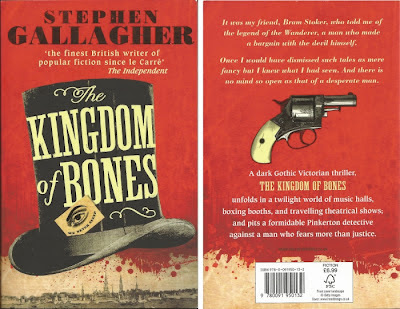
The British paperback edition of The Kingdom of Bones, the novel that introduces The Bedlam Detective's Sebastian Becker, is published today by Ebury Press.
Marilyn Stasio in The New York Times wrote:
Marilyn Stasio in The New York Times wrote:
THE KINGDOM OF BONES... shows the occult mystery in its best light. Vividly set in England and America during the booming industrial era of the late 19th and early 20th centuries, this stylish thriller conjures a perfect demon to symbolize the age and its appetites, an entity that inhabits characters eager to barter their souls for fame and fortune. When met, this demon is residing in Edmund Whitlock, an actor whose life gives us entry into the colorful world of traveling theatricals. When Whitlock passes on his curse to the company soubrette, the troupe manager follows her to America, intent on rescuing her, and runs afoul of the law. Although Gallagher delivers horror with a grand melodramatic flourish, his storytelling skills are more subtly displayed in scenes of the provincial theaters, gentlemen’s sporting clubs and amusement parks where a now-vanished society once took its rough pleasures.And this from crime titan Ed Gorman:
"I read Stephen Gallagher for two reasons. First because he's one of the most entertaining writers I've ever read. And second because I can't read a short story of his let alone a novel without picking up a few pointers about writing. He's an elegant stylist, a shrewd psychologist and a powerful storyteller with enormous range and depth.
"I finished his latest novel The Kingdom of Bones and I was honestly stunned by what he'd done. The sweep, the majesty, the grit, the grue, the great grief (and the underpinning of gallows humor from time to time). This is not only the finest novel I've read this year but the finest novel I've read in the past two or three years."

Tuesday, 27 November 2012
Best of 2012
Woo-hoo. Kirkus has named The Bedlam Detective as one of the best fiction titles of the year.
I believe a small glass of something may be called for.

The 'Read full review' link in the image won't work, but this one will.
While waiting for the softcover edition to be published in February, why not prepare the ground with Sebastian Becker's first outing in The Kingdom of Bones, in UK paperback from Ebury Press on December 6th?
No, you're quite right, I have no shame at all.
UPDATE: Click here to see all 100 titles in the Kirkus Best Fiction of 2012 list.
Saturday, 24 November 2012
Sherlocks
Like many people who'd embraced Sherlock I was prepared to dislike CBS's Elementary just on principle, but I don't. The Brooligan household watched the pilot and we decided, after some discussion, that it maybe wasn't for us; based on that first viewing it felt less than fresh, and the mystery element was weak. Subsequent episodes lurked around on the PVR until I came home late one night with a yen for something entertaining to unwind with. Elementary and I had found each other's level.
Here's the thing about American TV shows. Where British series can start out strongly and lose oomph as their overloaded creators run out of steam - witness the quality arc of Jonathan Creek, a Sherlock of the '90s - US series tend to find their feet as the team comes together. Much like the British Sherlock, the show's strength arises from a lead role played as a character part with all the stops out; though unlike the British version, Lucy Liu's Watson seems to be fading into the background with very little to do.
Comparisons are inevitable my sense is that Elementary's driven, dysfunctional take on a modern Sherlock owes more than a little to its British antecedent. Only a career-best performance from Jonny Lee Miller makes you rise above the thought that it's Benedict Cumberbatch's character with the serial numbers filed off. In fact you could pretty much swap the leads of the two versions, as Miller and Cumberbatch did nightly in the National Theatre's Frankenstein.
But the point was well made by a fan of both shows. With Sherlock, it's three a year. Fewer, if you average it out. Though it lost a couple of million viewers after the pilot, Elementary quickly got its 'back nine' pickup, extending the series order from thirteen episodes to a full season of twenty-two. CBS has since ordered a further two episodes to extend the season to twenty-four. It's a mass product for a mass market, and a successful one of its kind. And the more I see of it, the better it seems to get.
If we disdain something just because we think it's derivative, where will that leave us? Smug and pure, but with no popular culture and nothing to watch, that's where. You can have a preference, but it's still OK to see both. Life may be short, but it's not that short.
When I looked up Elementary's numbers, I was surprised to see how they compared to Eleventh Hour's in the same Thursday 10pm CBS slot. We got cancellation with a season's average of 12.15 million; Elementary's weekly average so far is 11.12 and they get a champagne party (as a continuing average that figure will reduce until the season's end, unless the lost 2 million from the pilot come back and rebalance it).
Here's the difference; Eleventh Hour was made for CBS by the Warner Bros studio. Elementary is made for CBS by CBS Studios. When the network pays its own studio for the show, the money stays in the family.
It's always about the numbers, but not necessarily about the numbers you think.
Wednesday, 14 November 2012
The Next Big Thing
Guy Adams, the Torchwood/Sherlock/Hammer novelist and Angry Robot-published author, has tagged me for this. I didn't even realise I'd annoyed him.
It's called a Blog Hop. Here's how it works, he said to me. You answer ten questions on the next big thing that you're working on, then tag five other writers to do the same. Which sounds a little bit like that "grains of rice on a chessboard" thing... within a matter of weeks it'll all reach a crisis, and we'll be fighting each other over the last few taggable authors with rock axes and knives made from dinosaur bones.

What is the working title of your next book?
Well, the next one to appear will be the UK edition of The Kingdom of Bones but the one I'm working on is the third novel featuring Sebastian Becker, which I'm calling The Authentic William James.
Where did the idea come from?
I got my villain first. Which makes a kind of sense when you think about it. In this kind of story, it's someone's misdeed that sets everything in motion. If that's credible and there's genuine human motivation behind it, your foundation's going to be strong.
What genre best defines your book?
It's a big dark historical crime thriller, set in 1913.
What actors would you choose to play the part of your characters in a movie?
Seriously, or in a fantasy-football-league sense? I'm not sure I can offer a thought for either. I'm not being evasive, but the career strategy issues and market politics of casting fascinate me. You don't often get the person you want. You get the most bankable person who needs your movie. If you're lucky, they'll connect with your vision to some extent; if they don't, you pretty much have to grin and suck it up. Having seen how it works, I find I can't do the speculation thing any more.
What is the one-sentence synopsis of your book?
A burning theatre, a kidnapped teen, and Sebastian Becker in pursuit of the morphine junkie cowboy that Buffalo Bill left behind.
Will your book be self-published or represented by an agency?
I'm represented. For the novels it's Howard Morhaim in New York, Abner Stein in London. For screen work I'm with UTA and The Agency. Please don't ask for an introduction. It doesn't work like that.
How long did it take you to write the first draft?
Ask me that when it's done. My first drafts are preceded by a lot of research and preparation. When I'm ready to sit down and pull it all together, it takes about twelve weeks.
What other books would you compare this story to within your genre?
I'm sui generis, apparently. Which I suspect may be a euphemism for "difficult to place".
Who or what inspired you to write this book?
All the Becker books include an element of Old Showbusiness. In The Kingdom of Bones it was a touring Victorian theatrical troupe, in The Bedlam Detective there's a crucial element tied in with early British cinema. For decades after William Cody's final UK tour, a number of British fairground families made their living with home-grown Western sideshows. They lived the life and learned the skills of shooting, roping, knife-throwing... and in the original show, one of Cody's performers did suffer a horrific riding accident and stayed on in Europe to recover. My what-if question - what if one of the British families took him in to lend their act some authenticity? Only to find that they'd opened up their family to an embittered monster? Everything flowed from there.
What else about the book might pique the reader's interest?
It's the third novel to feature Sebastian Becker, Special Investigator to the Lord Chancellor's Visitor in Lunacy. He makes his first appearance in The Kingdom of Bones, published in the UK by Ebury Press in December. The Bedlam Detective follows in February.
These "Next Big Thing" blogposts are planned to appear every Wednesday. For next week, I'm tagging fellow Suspensers Joel Goldman and Harry Shannon, Cumbria-based crime writer Zoë Sharp, adopted son of Chicago Tim Lees, and Prince of Brit Horror Stephen Laws.
It's called a Blog Hop. Here's how it works, he said to me. You answer ten questions on the next big thing that you're working on, then tag five other writers to do the same. Which sounds a little bit like that "grains of rice on a chessboard" thing... within a matter of weeks it'll all reach a crisis, and we'll be fighting each other over the last few taggable authors with rock axes and knives made from dinosaur bones.

What is the working title of your next book?
Well, the next one to appear will be the UK edition of The Kingdom of Bones but the one I'm working on is the third novel featuring Sebastian Becker, which I'm calling The Authentic William James.
Where did the idea come from?
I got my villain first. Which makes a kind of sense when you think about it. In this kind of story, it's someone's misdeed that sets everything in motion. If that's credible and there's genuine human motivation behind it, your foundation's going to be strong.
What genre best defines your book?
It's a big dark historical crime thriller, set in 1913.
What actors would you choose to play the part of your characters in a movie?
Seriously, or in a fantasy-football-league sense? I'm not sure I can offer a thought for either. I'm not being evasive, but the career strategy issues and market politics of casting fascinate me. You don't often get the person you want. You get the most bankable person who needs your movie. If you're lucky, they'll connect with your vision to some extent; if they don't, you pretty much have to grin and suck it up. Having seen how it works, I find I can't do the speculation thing any more.
What is the one-sentence synopsis of your book?
A burning theatre, a kidnapped teen, and Sebastian Becker in pursuit of the morphine junkie cowboy that Buffalo Bill left behind.
Will your book be self-published or represented by an agency?
I'm represented. For the novels it's Howard Morhaim in New York, Abner Stein in London. For screen work I'm with UTA and The Agency. Please don't ask for an introduction. It doesn't work like that.
How long did it take you to write the first draft?
Ask me that when it's done. My first drafts are preceded by a lot of research and preparation. When I'm ready to sit down and pull it all together, it takes about twelve weeks.
What other books would you compare this story to within your genre?
I'm sui generis, apparently. Which I suspect may be a euphemism for "difficult to place".
Who or what inspired you to write this book?
All the Becker books include an element of Old Showbusiness. In The Kingdom of Bones it was a touring Victorian theatrical troupe, in The Bedlam Detective there's a crucial element tied in with early British cinema. For decades after William Cody's final UK tour, a number of British fairground families made their living with home-grown Western sideshows. They lived the life and learned the skills of shooting, roping, knife-throwing... and in the original show, one of Cody's performers did suffer a horrific riding accident and stayed on in Europe to recover. My what-if question - what if one of the British families took him in to lend their act some authenticity? Only to find that they'd opened up their family to an embittered monster? Everything flowed from there.
What else about the book might pique the reader's interest?
It's the third novel to feature Sebastian Becker, Special Investigator to the Lord Chancellor's Visitor in Lunacy. He makes his first appearance in The Kingdom of Bones, published in the UK by Ebury Press in December. The Bedlam Detective follows in February.
~
These "Next Big Thing" blogposts are planned to appear every Wednesday. For next week, I'm tagging fellow Suspensers Joel Goldman and Harry Shannon, Cumbria-based crime writer Zoë Sharp, adopted son of Chicago Tim Lees, and Prince of Brit Horror Stephen Laws.
Kansas City-born Joel Goldman writes, "I became a ten-year overnight success with the publication of my first book, Motion To Kill, in 2002, introducing trial lawyer Lou Mason." Joel retired from his law practice in 2006 to write full-time, and has never looked back. His series include the Jack Davis thrillers and the soon-to-be-launched stories featuring Alex Stone, public defender.
Harry Shannon is a former actor, musician, Carolco VP, film music supervisor, now primarily a novelist with a sideline in short fiction. He's the author of the much-praised Mick Callahan novels. Media psychologist Callahan is "a failed Navy Seal, a recovering alcoholic and a loyal friend. He's also a man with a hot temper and a talent for getting himself into trouble."
Zoë Sharp is the creator of a series of novels featuring Charlotte 'Charlie' Fox, an action heroine who finds close protection work the perfect career for an ex-Special Forces trainee who has never been quite in step with life outside the army that rejected her. Zoë's hobbies are sailing, fast cars (and faster motorbikes), target shooting, travel, films, music, and reading just about anything she can get her hands on.
Tim Lees is a British author living in Chicago, responsible for numerous short stories and the pitch-perfect Frankenstein's Prescription, described as "a brilliant novel, one which takes the old stereotype and fills it with vibrant new life. The story is gripping, with each and every element of the plot fitting into place perfectly." (Peter Tennant, Black Static). It's available from Tartarus Press.
Newcastle-based Stephen Laws kicked off his career with Ghost Train. He's the author of 11 novels, numerous short stories (collected in The Midnight Man), as well as a columnist, reviewer, film-festival interviewer, pianist and recipient of numerous awards. He survived an early attempt by his publisher to promote him as "A Herbert for the 90s". Read about his heroic encounter with a Spanish zombie master here.
Subscribe to:
Posts (Atom)


 Posts


