
Tuesday, 17 September 2013


Thursday, 12 September 2013
The Returning Drama Series
As well as its full-time MA studies the London Film School runs a number of part-time courses for screenwriters and filmmakers. They're professional training so they're not cheap, but if you've reached a point in your career where you can make use of industry insight then they can be of real value.
In November/December there are eight places available on this one, aimed at developing ideas for returning drama series and covering six workshop days and three masterclasses.
(The other two Masterclasses will be given by Lucy Gannon and Ashley Pharoah, whose returnable dramas have a track record of actually returning)
Some years back I laid out my own money on a MediaXchange weekend of panels and exercises with American showrunners, and it completely changed my attitude to the business. It would be at least a decade before I'd be able to put any of what I learned into practice, but now I'd seen what a professionalised writers' system looked like and the hunger for something better - for a system where you didn't just write a script but went on to steer it though production, and where work that was asked for always had to be paid for - never went away.
Going Again: Creating and Developing Returnable Drama Series LFS, November/December £800
The London Film School is situated in Covent Garden, down a side-street past the Pineapple Dance Studios and what I remember as a quite decent Mexican restaurant.
I believe the course will be followed by a networking booze-up some time in January. Or that might just be in my imagination.
In November/December there are eight places available on this one, aimed at developing ideas for returning drama series and covering six workshop days and three masterclasses.
In this series of workshops we will be working with professional television writers, ideally with at least three broadcast TV credits, on developing original drama series Bibles for shows that can then be pitched to the British networks.I'll be giving one of the masterclasses and I ought to be held up as Mister Bad Example, given that some of the best shows I've worked on never made it to a second season. It's hard to think of them as returning dramas when they didn't return. But everything eventually ends in cancellation, is my attitude, and anything you can get away before that counts as a win.
(The other two Masterclasses will be given by Lucy Gannon and Ashley Pharoah, whose returnable dramas have a track record of actually returning)
Some years back I laid out my own money on a MediaXchange weekend of panels and exercises with American showrunners, and it completely changed my attitude to the business. It would be at least a decade before I'd be able to put any of what I learned into practice, but now I'd seen what a professionalised writers' system looked like and the hunger for something better - for a system where you didn't just write a script but went on to steer it though production, and where work that was asked for always had to be paid for - never went away.
Going Again: Creating and Developing Returnable Drama Series LFS, November/December £800
The London Film School is situated in Covent Garden, down a side-street past the Pineapple Dance Studios and what I remember as a quite decent Mexican restaurant.
I believe the course will be followed by a networking booze-up some time in January. Or that might just be in my imagination.
Tuesday, 10 September 2013
To Hull and Back
Hull's on the shortlist of four for City of Culture, 2017. The bid submission's going in at the end of this month and when asked if I'd support it with some kind of personal statement, here's what I wrote:

If I have to explain further, then we're probably both wasting our time.
UPDATE:
Thanks to Mark Healey for this Hepworths Arcade pic, taken on Saturday.


I came to Hull in 1972 to begin what would prove to be the most important years of my young life and future career. My time with the University's Drama and English departments wasn't a hasty syllabus of printed handouts and "reading weeks" but a real, eye-opening, immersive education in which the city itself played a seamless part. In the cinema club under the Central Library I had my first sight of the films of Andrei Tarkovsky, and shook the hand of Peter Cushing. Heard my first live Mahler at the Philharmonic. Chose a favourite picture at the Ferens Gallery (Alexander Slaying Cleitus, Daniel de Blieck - not for the action, but for the control of space). Hull Truck was a young theatre company laying the groundwork of a national reputation while Hull's touring venues played host to a range of guests and visitors, from the fledgling Actors' Company revival of a rare Chekov with Ian McKellen, to the awesome old-school stagecraft of Morecambe and Wise.I sense your curiosity about the choice of picture. I was actually looking online for a shot of Hepworth's Arcade on Silver Street, one of my favourite places in the city, when I came across this image of the Health Department's ace ratcatcher on the History Centre's website.
Hull was famous, then and now, for producing students who found it hard to tear themselves away. Though I left at the end of my time, I'm proud to maintain some links. I've life membership of the Friends of the Gulbenkian (the University's unique purpose-built teaching theatre). All my drafts and working papers go into the care of the Hull History Centre, a state-of-the-art archive at the forefront of international research into the challenges of long-term digital storage. Every year I swear I'll revisit the unforgettable fair, and someday I will.
Why City of Culture 2017? These have been hard decades for the creative life of every British town but in Hull there's a significant cultural infrastructure to be saved, preserved, restored and reinforced. I'm one of the many who have been equipped by the partnership of city and university to take that spirit forward. I'd like to see it continue through further generations; I can't imagine a better investment, or a finer legacy.
If I have to explain further, then we're probably both wasting our time.
UPDATE:
Thanks to Mark Healey for this Hepworths Arcade pic, taken on Saturday.
Tuesday, 27 August 2013
No You Don't
Movies about magicians are tricky.
OK, now we've got that out of the way, let me explain. One of my less satisfying viewing experiences of the summer was a heist movie called Now You See Me, the premise for which involved four illusionists teaming up and combining their skills to pull off a series of spectacular and ingenious crimes.
The spectacle was there but key moments of that ingenuity were achieved with VFX rather than performance skills. So where's the point? Magic, like dance, is one of those things that you appreciate because a human being is doing it.
In the early days of television, screen magicians understood that without a perception of honesty in the presentation, the person-to-person trickery has no value. So no cuts, no camera tricks. We expect to be fooled, but not cheated of any chance to spot how. In these less principled times, when exposed dishonesty has been rebranded as 'constructed reality' and no one admits disgrace, it's possible to see concocted TV magic where no magic is performed at all - a performer pretends to do a trick, a crowd of stooges pretends to be amazed, and the trick itself is faked in the edit. Check out online magic forums to see other magicians calling out the offenders.
But what does that matter in a movie? They're actors, not magicians, any more than Natalie Portman and Mila Kunis are ballerinas. And the actors do a creditable amount of work to convince us that they can do this stuff. Many of the story's illusions mimic famous effects, and magic advisor David Kwong was involved at the scripting stage:
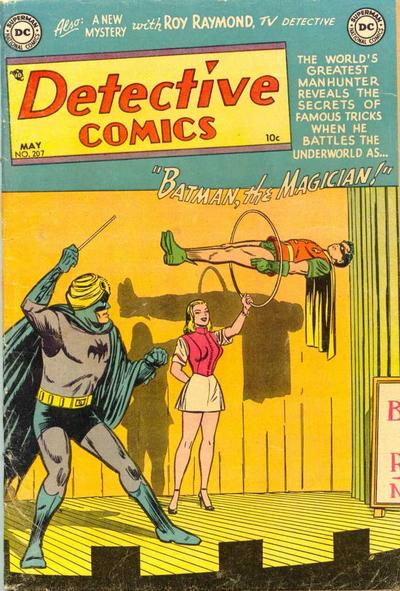
Now You See Me's problem is that the Trouble rarely convinces. So for now, I'll have to make do with this.

OK, now we've got that out of the way, let me explain. One of my less satisfying viewing experiences of the summer was a heist movie called Now You See Me, the premise for which involved four illusionists teaming up and combining their skills to pull off a series of spectacular and ingenious crimes.
The spectacle was there but key moments of that ingenuity were achieved with VFX rather than performance skills. So where's the point? Magic, like dance, is one of those things that you appreciate because a human being is doing it.
In the early days of television, screen magicians understood that without a perception of honesty in the presentation, the person-to-person trickery has no value. So no cuts, no camera tricks. We expect to be fooled, but not cheated of any chance to spot how. In these less principled times, when exposed dishonesty has been rebranded as 'constructed reality' and no one admits disgrace, it's possible to see concocted TV magic where no magic is performed at all - a performer pretends to do a trick, a crowd of stooges pretends to be amazed, and the trick itself is faked in the edit. Check out online magic forums to see other magicians calling out the offenders.
But what does that matter in a movie? They're actors, not magicians, any more than Natalie Portman and Mila Kunis are ballerinas. And the actors do a creditable amount of work to convince us that they can do this stuff. Many of the story's illusions mimic famous effects, and magic advisor David Kwong was involved at the scripting stage:
CGI was employed in hand doubling for more elaborate moves and one trick where Fisher’s character floats above the audience in a bubble. “They’re portrayed as the magicians of tomorrow,” he says. “The director asked me what tricks I wanted to do, but never quite had the method for them."That's where the film falls down, in director Louis Leterrier 's cavalier use of what's been placed at his disposal. There are tricks here that look like known tricks, but with a damaging sense of no method behind them. Behind all magic stands hard science. As Christopher Priest suggested in The Prestige, the most significant element in an illusion is the invisible work behind it, referred to as The Trouble. With its emphasis on planning, execution, and surprise, The Trouble is also a fair description of what makes a successful heist movie tick.
Now You See Me's problem is that the Trouble rarely convinces. So for now, I'll have to make do with this.
Wednesday, 21 August 2013
New Stories

On sale from August 24th is Thirteen, an audio anthology available for MP3 download with a CD version to follow. Thirteen is...
...presented as a portmanteau anthology, with an umbrella story tying all 13 stories together, and produced with appropriate sound effects to give the impression of an old vinyl recording - a homage to the horror LPs of the 60s and 70s.My story is titled With Her in Spirit and is read by Frances Barber.
Yeah, Frances Barber. How about that?
There's a full list of stories and performers at the Spokenworld Audio website. The other contributors include Kim Newman, Mark Morris, and Simon Clark, with readings by Arthur Darville, Gemma Arterton, Greg Wise, Lalla Ward... don't make me list 'em all, click on the link and take a look for yourself.
Then in November there'll be Twisted Histories, a paperback anthology from Snowbooks which includes my story Blame the French. More about that one nearer the date.

Monday, 5 August 2013
Who's Who
So we made it back from London just in time to catch the second half of the BBC's live announcement of the new Doctor Who casting, settling down before the TV with the Bargain Bucket we'd picked up on the way home. We hadn't been rushing back, or anything. Twitter was hardly likely to be silent on the subject in the coming hours. Not if the past few months have been anything to go by.
Given that I wasn't particularly invested, I was surprised to feel oddly moved when Capaldi stepped out. It was a nice moment and it felt right in all kinds of ways. I have no form when it comes to anticipating Who recastings; I'd never have predicted Smith, Tennant or Eccleston. Now I see them all as manifestly right moves... with the possible exception of Eccleston, who for me will always be the odd-man-out Doctor.
I'm not saying he didn't work. One of my favourite "Welsh Who" stories is an Eccleston episode, Rob Shearman's Dalek. But his leather-jacketed rough-edged Everyman seemed to stand outside the parameters of a character that, until that point, I'd imagined had none. A strength of the format, I'd always assumed, was that the Doctor could be anybody. But suddenly I could see a testing of the hidden limitations behind that illusion of infinite possibility.
With Tennant and then Smith we were back within the parameters, whatever they are. Don't ask me to define them; casting is an art, not a science. Nor is it an opportunity for social engineering; it's high-stakes showbusiness, with a massive commercial decision resting on a producer's shoulders. Moffat is not only tasked with making the decision, but with making the decision work.
Were I in the hot seat, I'd have cast Capaldi like a shot. He's been on my male-lead wishlist for almost every project of the last 20 years, and the fact that he's never appeared in anything of mine is a sign of the regard usually given to a writer's casting thoughts. I suppose it's ironic that he's now on the show when I'm not. But there you go.
And people complaining that he's too old; f*** you, he's younger than me.
Given that I wasn't particularly invested, I was surprised to feel oddly moved when Capaldi stepped out. It was a nice moment and it felt right in all kinds of ways. I have no form when it comes to anticipating Who recastings; I'd never have predicted Smith, Tennant or Eccleston. Now I see them all as manifestly right moves... with the possible exception of Eccleston, who for me will always be the odd-man-out Doctor.
I'm not saying he didn't work. One of my favourite "Welsh Who" stories is an Eccleston episode, Rob Shearman's Dalek. But his leather-jacketed rough-edged Everyman seemed to stand outside the parameters of a character that, until that point, I'd imagined had none. A strength of the format, I'd always assumed, was that the Doctor could be anybody. But suddenly I could see a testing of the hidden limitations behind that illusion of infinite possibility.
With Tennant and then Smith we were back within the parameters, whatever they are. Don't ask me to define them; casting is an art, not a science. Nor is it an opportunity for social engineering; it's high-stakes showbusiness, with a massive commercial decision resting on a producer's shoulders. Moffat is not only tasked with making the decision, but with making the decision work.
Were I in the hot seat, I'd have cast Capaldi like a shot. He's been on my male-lead wishlist for almost every project of the last 20 years, and the fact that he's never appeared in anything of mine is a sign of the regard usually given to a writer's casting thoughts. I suppose it's ironic that he's now on the show when I'm not. But there you go.
And people complaining that he's too old; f*** you, he's younger than me.
Monday, 29 July 2013
Of Shadows and Pilgrims

A shout-out for this one-hour SF comedy, beginning a 6-night run at the West End's Tristan Bates Theatre this evening at 7.30.
Written and directed by Stephen Jordan and featuring Cliff Chapman and Adam Joselyn, it's presented by Manmoth Productions as part of the Camden Fringe and is a FringeReview Hot Pick.
Why the shout? Well, a) it's smart and funny, and b) its Associate Producer is Ellen Gallagher, aka Little Miss Brooligan, whose mission in life seems to be to erase my name and steal all my friends. By day she can be found in the Media Department of the Blake Friedmann Agency. At night, just follow the noise to the relevant karaoke bar.
The same team were responsible for last year's Fringe success Dead Static, which opened at the Etcetera Theatre and went on for a further run at The Hen and Chickens. It's now available as an audio drama, free to stream or download during Pilgrim Shadow's run.
See you there?
Tuesday, 23 July 2013
The Opinionated Writer, Part Four
Earlier this year I gave long answers to some very basic questions for a film student's diploma dissertation. This is the last, and the briefest.
Which companies have you worked for? What are they like to work for? Are there differences in styles and techniques?
Off the top of my head -- the BBC, ITV, BBC Films, Zenith, Carnival, Gaumont, Power TV, Jerry Bruckheimer, Warner Bros, CBS, Fox, NBC, ABC, most of them several times. You can find my full credits list in the IMDB but that's only a partial snapshot of my career because there's no mention there of the 14 novels, the early radio dramas where I learned my craft, or any of the companies
I've developed stuff with that didn't get made, including at least four feature screenplays.
Most people along the way have been good to work with. My style and technique don't really vary as I move from one place to another, because that's what they come to me for.
Which companies have you worked for? What are they like to work for? Are there differences in styles and techniques?
Off the top of my head -- the BBC, ITV, BBC Films, Zenith, Carnival, Gaumont, Power TV, Jerry Bruckheimer, Warner Bros, CBS, Fox, NBC, ABC, most of them several times. You can find my full credits list in the IMDB but that's only a partial snapshot of my career because there's no mention there of the 14 novels, the early radio dramas where I learned my craft, or any of the companies
I've developed stuff with that didn't get made, including at least four feature screenplays.
Most people along the way have been good to work with. My style and technique don't really vary as I move from one place to another, because that's what they come to me for.
 |
| Parking space on the Warner Bros lot. The paint takes one season to fade away. |
Monday, 22 July 2013
The Opinionated Writer, Part Three
Earlier this year I gave long answers to some very basic questions for a film student's diploma dissertation.
How would you go about selling a script or concept? Can you sell a concept?
You can sell a concept, and people do it all the time, but it has its hazards. Because, see above - if you've sold a concept then you've then got to find its form with the added pressure of people invested and breathing down your neck. So in my case, when I pitch a concept, I've got the completed plan already thought-out. Not in minute detail, but in the broad strokes. If rushed it's very easy to make lazy choices - of characters, motives, and incidents drawn from other films and TV - and once those are locked-in, you're stuck with them. You'll see many a film or TV show where the one-line concept is intriguing but the characters and situations are all stock.
US TV has a 'pitching season' in the middle of the year when all the broadcast and cable companies open their doors to new material, and producers book appointments to go in with their writers and pitch the show they've been developing together. You get about 20 minutes to explain your show to a listening team of four or five executives, and then it's the next team's turn. Sometimes - rarely - a pitch will be bought 'in the room'. More often you'll hear back within a couple of days, a week at the most.
In the UK it's way less organised. A broadcaster will circulate a note to production companies to say they don't want to see any more crime shows but they're in the market for an inner-city medical series about Travellers. Every producer contacts their regular writers and works up a Big Fat Gypsy Medic pitch. All the pitches come in at the same time. Meanwhile the broadcaster buys something completely different, probably a crime show. I've lost count of the number of times I've seen this happen.
Are there certain rules about production companies wanting in-house staff writers?
The US hires writers and the UK buys stories. Every US show is staff-written with almost no openings for freelancers. There's a 'staffing season' that comes right after 'pilot pickup season', where the showrunners of new shows read script samples and hire that season's team. There's a ranking order to the job titles with Executive Producer at the top, then co-exec, then supervising producer, story editor, consulting producer, staff writer. All are writers, and each will probably have two scripts in the season with their byline. On those scripts they'll be the prime writer, though the story will have been worked-over and beefed up by everyone in the Writers' Room and the showrunner will give it a final pass for style and consistency. Staff Writer is the 'entry level' job. People get to be staff writers by writing 'spec scripts' of shows they don't work on, to show as writing samples. Every writer on the team has a personal project of their own that they someday hope to sell.
In the UK, the episodic series producer will first approach writers he or she has worked with before, and then will put out a call to agents for potential contributors. Then a meeting or a phonecall in which the producer describes the show to the prospective writer, who then goes away and cooks up two or three story ideas. It may go further, it may not. If it doesn't, the writer's been working for nothing. In my experience of such series the writer usually doesn't meet the creator or any of the other writers. In my humble opinion this is a vastly inferior system. The few times I've seen a UK production attempt to imitate the American system, it's stumbled at the British reluctance to commit to a writers' talent and put them on staff to produce material. They want to see the story and then buy it.
Soaps are different, employing storyliners who supply detailed outlines to a pool of scriptwriters, but they still depend on the freelance model. Producers are trusted to be paid a salary for work they haven't done yet, writers aren't.
How would you go about selling a script or concept? Can you sell a concept?
You can sell a concept, and people do it all the time, but it has its hazards. Because, see above - if you've sold a concept then you've then got to find its form with the added pressure of people invested and breathing down your neck. So in my case, when I pitch a concept, I've got the completed plan already thought-out. Not in minute detail, but in the broad strokes. If rushed it's very easy to make lazy choices - of characters, motives, and incidents drawn from other films and TV - and once those are locked-in, you're stuck with them. You'll see many a film or TV show where the one-line concept is intriguing but the characters and situations are all stock.
US TV has a 'pitching season' in the middle of the year when all the broadcast and cable companies open their doors to new material, and producers book appointments to go in with their writers and pitch the show they've been developing together. You get about 20 minutes to explain your show to a listening team of four or five executives, and then it's the next team's turn. Sometimes - rarely - a pitch will be bought 'in the room'. More often you'll hear back within a couple of days, a week at the most.
In the UK it's way less organised. A broadcaster will circulate a note to production companies to say they don't want to see any more crime shows but they're in the market for an inner-city medical series about Travellers. Every producer contacts their regular writers and works up a Big Fat Gypsy Medic pitch. All the pitches come in at the same time. Meanwhile the broadcaster buys something completely different, probably a crime show. I've lost count of the number of times I've seen this happen.
Are there certain rules about production companies wanting in-house staff writers?
The US hires writers and the UK buys stories. Every US show is staff-written with almost no openings for freelancers. There's a 'staffing season' that comes right after 'pilot pickup season', where the showrunners of new shows read script samples and hire that season's team. There's a ranking order to the job titles with Executive Producer at the top, then co-exec, then supervising producer, story editor, consulting producer, staff writer. All are writers, and each will probably have two scripts in the season with their byline. On those scripts they'll be the prime writer, though the story will have been worked-over and beefed up by everyone in the Writers' Room and the showrunner will give it a final pass for style and consistency. Staff Writer is the 'entry level' job. People get to be staff writers by writing 'spec scripts' of shows they don't work on, to show as writing samples. Every writer on the team has a personal project of their own that they someday hope to sell.
In the UK, the episodic series producer will first approach writers he or she has worked with before, and then will put out a call to agents for potential contributors. Then a meeting or a phonecall in which the producer describes the show to the prospective writer, who then goes away and cooks up two or three story ideas. It may go further, it may not. If it doesn't, the writer's been working for nothing. In my experience of such series the writer usually doesn't meet the creator or any of the other writers. In my humble opinion this is a vastly inferior system. The few times I've seen a UK production attempt to imitate the American system, it's stumbled at the British reluctance to commit to a writers' talent and put them on staff to produce material. They want to see the story and then buy it.
Soaps are different, employing storyliners who supply detailed outlines to a pool of scriptwriters, but they still depend on the freelance model. Producers are trusted to be paid a salary for work they haven't done yet, writers aren't.
Friday, 19 July 2013
The Opinionated Writer, Part Two
Earlier this year I gave long answers to some very basic questions for a film student's diploma dissertation.
Is there a difference in writing for UK and US audiences, and if there is, what is it (cost, budget, more/less freedom)?
I don't think the audiences are that different, but I find that the commissioning cultures are. I much prefer dealing with the US, where they don't fanny around. There I've pitched a script in the morning and had a Yes before lunchtime. The energy level's higher and if something doesn't work out, it doesn't count against you. You've simply proved yourself a player. UK commissioners are unclear on what they want and indecisive over what they're shown, and they have no concept of the value of a fast No.
In the writing I don't really discriminate between US and UK because the stuff I do tends to work in either venue. Either that or I've always been a misplaced American TV writer at heart and that would explain why getting every one of my UK projects made has been like re-inventing the wheel. I like US pace and structure. To me it's all about witnessing things as they happen, not watching conversations about events.
Budget's not such an issue at the concept stage where the ideas set the agenda. Once a show is under way then budget is a factor, because it's been set before the scripts are written. Every episode is scheduled for, say, 8 shooting days, with maybe 5 of them in the studio and 3 of them 'out'. In the studio you'll want to make maximum use of your standing sets, and on your 'out' days you'll want to combine locations to minimise time-consuming crew moves. I once had to lose a crowd scene in order to be able to afford a submarine. You can call that a limiting of freedom; to me it's just the way to what you want.
What are the differences between original material and adaptations?
With an adaptation you're spared the sweaty anxiety of the early stages where you have an idea, and you feel it's good, but you don't yet know if there's a form in which it will work. When you're adapting your own work or someone else's, that question's already been solved. You may need to come up with a radical reconception of form to take it from one medium to another, but the baseline is that the ideas fit together, they go somewhere, and there's a pool of characters and incidents to draw upon.
With an original, you first have to do all the work that gets you up to that baseline. For me it's the crucial part. It's satisfying but it's not enjoyable.
Is there a difference in writing for UK and US audiences, and if there is, what is it (cost, budget, more/less freedom)?
I don't think the audiences are that different, but I find that the commissioning cultures are. I much prefer dealing with the US, where they don't fanny around. There I've pitched a script in the morning and had a Yes before lunchtime. The energy level's higher and if something doesn't work out, it doesn't count against you. You've simply proved yourself a player. UK commissioners are unclear on what they want and indecisive over what they're shown, and they have no concept of the value of a fast No.
In the writing I don't really discriminate between US and UK because the stuff I do tends to work in either venue. Either that or I've always been a misplaced American TV writer at heart and that would explain why getting every one of my UK projects made has been like re-inventing the wheel. I like US pace and structure. To me it's all about witnessing things as they happen, not watching conversations about events.
Budget's not such an issue at the concept stage where the ideas set the agenda. Once a show is under way then budget is a factor, because it's been set before the scripts are written. Every episode is scheduled for, say, 8 shooting days, with maybe 5 of them in the studio and 3 of them 'out'. In the studio you'll want to make maximum use of your standing sets, and on your 'out' days you'll want to combine locations to minimise time-consuming crew moves. I once had to lose a crowd scene in order to be able to afford a submarine. You can call that a limiting of freedom; to me it's just the way to what you want.
What are the differences between original material and adaptations?
With an adaptation you're spared the sweaty anxiety of the early stages where you have an idea, and you feel it's good, but you don't yet know if there's a form in which it will work. When you're adapting your own work or someone else's, that question's already been solved. You may need to come up with a radical reconception of form to take it from one medium to another, but the baseline is that the ideas fit together, they go somewhere, and there's a pool of characters and incidents to draw upon.
With an original, you first have to do all the work that gets you up to that baseline. For me it's the crucial part. It's satisfying but it's not enjoyable.
Wednesday, 17 July 2013
The Opinionated Writer, Part One
Earlier this year I gave long answers to some very basic questions for a film student's diploma dissertation.
I had two aims in mind, beyond the obvious one of helping him out. One was that I'd eventually put the material online for general use (so other film students, take from this what you will and don't email asking me to write your essay for you).
The other involved the hope that I might inject a little contemporary awareness into academia, after hearing of a student on a script editing course being scoffed at for suggesting that the US TV writer's experience can be better than here. But she was right - those epic horror stories from LA-bruised Brits are not the norm.
I've a lot of friends, colleagues and Twitterpals in the business who work in areas that I don't, and usually in a piece like this I'd stop along the way to consider and qualify some of my remarks with them in mind. Here I just kind of charged on through. So if you want to take exception to anything, by all means do; and if you want to blog a riposte to any of these points, let me know and I may embed a link.
It's in four sections. The others are scheduled to appear over the next few days.
So here goes.
What are the differences between writing for TV and for film?
I have to break this into two parts because there's 1) the conceptual difference in the two dramatic forms, and then 2) the difference in working practice.
1) I've heard it said that if something remarkable happens to people once in in a lifetime then it's a movie, but if something remarkable happens to them every week then it's television. A film story fashions a universal myth out of its material. Television drama approaches the universal from another angle, taking the myth apart and finding the domestic details that build toward it. When you have nothing but the domestic details, to no ultimate purpose, you have a soap.
2) Most starting-out writers dream of selling a feature screenplay, but all the feature writers want to get into television where they'll have greater opportunities for expression and control. See Ted Griffin, Graham Yost, David Goyer. It wasn't always that way - TV used to be seen as a lesser medium with lower budgets and lesser ambitions - but that's changed. They've now become very different beasts. As feature budgets have grown, their choices have become safer and safer. In features the writer is required to serve the director's vision, and is a replaceable component. In TV - and especially in American TV - the director's job is to get the showrunner's vision onto the screen. The showrunner is an industry-trained writer in charge of a writing team and a production machine. He or she will most likely have conceived and pitched the idea to the network and written the pilot, although sometimes an experienced showrunner is hired to take charge of a series conceived by an inexperienced creator. The UK has yet to fully embrace the showrunner concept. In the UK writers are mostly shut out of production so they'll rarely have any hands-on production experience.
How much influence do producers have over your work?
The two equally valid answers are, none, and huge. None because, as a writer, the thing that gives you value is your unique point of view. If you don't have that, if you only ever write to assignment or chase the market, then you're aiming no higher than the second division. You should conceive your ideas with no thought of catering to anyone else. And huge because, once you find a producer who picks up on your point of view and believes that what you're doing is what he or she has been looking for, then you enter a partnership in which the other person steers. I've known that go well and I've known it go horribly wrong. They can hire a 'visual' director with no narrative gift, or one of the known 'writer-killers' who don't respect the script. They can miscast key roles. In a worst-case scenario they can replace you with an untalented friend.
I had two aims in mind, beyond the obvious one of helping him out. One was that I'd eventually put the material online for general use (so other film students, take from this what you will and don't email asking me to write your essay for you).
The other involved the hope that I might inject a little contemporary awareness into academia, after hearing of a student on a script editing course being scoffed at for suggesting that the US TV writer's experience can be better than here. But she was right - those epic horror stories from LA-bruised Brits are not the norm.
I've a lot of friends, colleagues and Twitterpals in the business who work in areas that I don't, and usually in a piece like this I'd stop along the way to consider and qualify some of my remarks with them in mind. Here I just kind of charged on through. So if you want to take exception to anything, by all means do; and if you want to blog a riposte to any of these points, let me know and I may embed a link.
It's in four sections. The others are scheduled to appear over the next few days.
So here goes.
What are the differences between writing for TV and for film?
I have to break this into two parts because there's 1) the conceptual difference in the two dramatic forms, and then 2) the difference in working practice.
1) I've heard it said that if something remarkable happens to people once in in a lifetime then it's a movie, but if something remarkable happens to them every week then it's television. A film story fashions a universal myth out of its material. Television drama approaches the universal from another angle, taking the myth apart and finding the domestic details that build toward it. When you have nothing but the domestic details, to no ultimate purpose, you have a soap.
2) Most starting-out writers dream of selling a feature screenplay, but all the feature writers want to get into television where they'll have greater opportunities for expression and control. See Ted Griffin, Graham Yost, David Goyer. It wasn't always that way - TV used to be seen as a lesser medium with lower budgets and lesser ambitions - but that's changed. They've now become very different beasts. As feature budgets have grown, their choices have become safer and safer. In features the writer is required to serve the director's vision, and is a replaceable component. In TV - and especially in American TV - the director's job is to get the showrunner's vision onto the screen. The showrunner is an industry-trained writer in charge of a writing team and a production machine. He or she will most likely have conceived and pitched the idea to the network and written the pilot, although sometimes an experienced showrunner is hired to take charge of a series conceived by an inexperienced creator. The UK has yet to fully embrace the showrunner concept. In the UK writers are mostly shut out of production so they'll rarely have any hands-on production experience.
How much influence do producers have over your work?
The two equally valid answers are, none, and huge. None because, as a writer, the thing that gives you value is your unique point of view. If you don't have that, if you only ever write to assignment or chase the market, then you're aiming no higher than the second division. You should conceive your ideas with no thought of catering to anyone else. And huge because, once you find a producer who picks up on your point of view and believes that what you're doing is what he or she has been looking for, then you enter a partnership in which the other person steers. I've known that go well and I've known it go horribly wrong. They can hire a 'visual' director with no narrative gift, or one of the known 'writer-killers' who don't respect the script. They can miscast key roles. In a worst-case scenario they can replace you with an untalented friend.
Saturday, 13 July 2013
The Long Road to Bedlam
At the request of crime specialist and site editor Barry Forshaw, I wrote a piece for the Interviews section of the Crime Time online website. Here's a taster:
There are two kinds of characters that carry novel series. They're devised or they're grown, and those are quite different beasts. The devised character is like a track car, stripped of all unnecessary parts in order to run and run. The art in the creation of such a series hero is assemble just enough well-chosen characteristics to give the illusion of a character without the encumbrances of personal development. As readers, we're complicit in this. We accept Mike Hammer's life of brutal solitude without questioning from where, exactly, comes this infinite supply of Old Friends who show up needing his help.And you can read the rest here, if so inclined.
Subscribe to:
Posts (Atom)


 Posts
Posts


