Congratulations to Hull on the winning bid. No doubt there'll be the usual city-what-culture snark but my memories of Hull are all good ones, of deep history and atmospheric landscape and unique creative energy. Down River was my love letter to Humberside and the East Yorkshire coast.
For all those cities in competition, apparently the very act of getting a bid together has been proven to affect cultural life and economy; almost as if the morale of the public had a value.
Imagine that. Hope and happiness mattering. You wouldn't guess it from the way we're being driven, would you?
Wednesday, 20 November 2013


Monday, 18 November 2013
Who Day
Saturday's Dr Who day (Doctor Who: The Science Behind the Scenes, University of Central Lancashire) was great fun, as these things always are. When people come together for an occasion like this one, there's an air of cynicism-free joy that's completely at odds with some of the online griping you see. Which leads me to think that maybe the online griping is just the Grinch joining in with the fun.
Key to it all is the presence of the bright and very young, I think. The day was advertised as 'for ages 12 and up', which is in contrast to those BBC-backed fan affairs recommended for adults only. Dr Who is a children's show that doesn't talk down to its audience, and they rise to meet it as children will. Which makes it a canny move by UCLAN to stage the event, and not to dumb it down. It was effectively an Open Day for future undergraduates, with real lectures in a real lecture theatre, the odd quiz, and cosplay and props courtesy of Hyde Fundraisers.
(If you think that raises unrealistic expectations for student life, you've obviously forgotten Freshers' Week.)
I showed up for my bit, but I stayed all day. Even had a signing line which meant that I missed the beginning of Dr Sarita Robinson's talk on The Psychology of Dr Who - but no worries, I got to catch up with her to-camera piece for the Special Features on the Day of the Daleks DVD. This wasn't soft stuff. The point being that the imagined wonders of Who open doors to real questions of cosmology, psychology, and the nature of time itself.
I've one regret, which is that at the end of my Q&A, when asked what advice I'd give to aspiring writers, I kicked off with, "Don't go on courses, don't trust books," which is a pretty ungracious thing to hear from a guest in an educational setting. The fact is, I've friends who run courses. I've shown up and done guest spots, and I've mentored screenwriting students. What I meant to urge was an attitude of mind; don't expect to be guided, don't look for a map. Approach such things as an explorer, with an eye to what you can steal and co-opt to your purpose. If I'd been a bit less shoot-from-the-hip, I'd have had the wits to say so.
I was rubbish at the quiz, as well.
UPDATE: There's a report by David MacGowan on the full day here, complete but for mention of Dr Ian Turner's entertaining and informative The Science of Doctor Who, which was conducted with s great sense of fun in the persona of the Doctor himself. David was watching a screening of Warriors' Gate during that hour, so I guess he's excused.
Key to it all is the presence of the bright and very young, I think. The day was advertised as 'for ages 12 and up', which is in contrast to those BBC-backed fan affairs recommended for adults only. Dr Who is a children's show that doesn't talk down to its audience, and they rise to meet it as children will. Which makes it a canny move by UCLAN to stage the event, and not to dumb it down. It was effectively an Open Day for future undergraduates, with real lectures in a real lecture theatre, the odd quiz, and cosplay and props courtesy of Hyde Fundraisers.
(If you think that raises unrealistic expectations for student life, you've obviously forgotten Freshers' Week.)
I showed up for my bit, but I stayed all day. Even had a signing line which meant that I missed the beginning of Dr Sarita Robinson's talk on The Psychology of Dr Who - but no worries, I got to catch up with her to-camera piece for the Special Features on the Day of the Daleks DVD. This wasn't soft stuff. The point being that the imagined wonders of Who open doors to real questions of cosmology, psychology, and the nature of time itself.
I've one regret, which is that at the end of my Q&A, when asked what advice I'd give to aspiring writers, I kicked off with, "Don't go on courses, don't trust books," which is a pretty ungracious thing to hear from a guest in an educational setting. The fact is, I've friends who run courses. I've shown up and done guest spots, and I've mentored screenwriting students. What I meant to urge was an attitude of mind; don't expect to be guided, don't look for a map. Approach such things as an explorer, with an eye to what you can steal and co-opt to your purpose. If I'd been a bit less shoot-from-the-hip, I'd have had the wits to say so.
I was rubbish at the quiz, as well.
UPDATE: There's a report by David MacGowan on the full day here, complete but for mention of Dr Ian Turner's entertaining and informative The Science of Doctor Who, which was conducted with s great sense of fun in the persona of the Doctor himself. David was watching a screening of Warriors' Gate during that hour, so I guess he's excused.
Monday, 28 October 2013
Doctor Who: The Science Behind the Scenes
Lancashire Science Festival Presents
Doctor Who: The Science Behind the Scenes on Saturday 16 November 2013, 09:30am - 16:00pm in the Darwin Building, University of Central Lancashire, Marsh Lane, Preston, PR1 2HE.
£5 for full day entry (access to all sessions), free entry to the festival activities (excluding sessions) and free parking (see details on their website)
"To celebrate 50 years of Doctor Who, the Lancashire Science Festival proudly presents Doctor Who: The Science Behind the Scenes. Have you ever wondered whether the Doctor's time travelling antics were really possible? And if so, how? Please note that this event is aimed at ages 12 and above."
And here's the bit that I''m involved in:
**BREAKING NEWS!**
Doctor Who Screenwriter Stephen Gallagher will be attending the festival and giving a Q&A (paid tickets only) and Autograph Signing Session at 1pm!
£5 for full day entry (access to all sessions), free entry to the festival activities (excluding sessions) and free parking (see details on their website)
"To celebrate 50 years of Doctor Who, the Lancashire Science Festival proudly presents Doctor Who: The Science Behind the Scenes. Have you ever wondered whether the Doctor's time travelling antics were really possible? And if so, how? Please note that this event is aimed at ages 12 and above."
And here's the bit that I''m involved in:
**BREAKING NEWS!**
Doctor Who Screenwriter Stephen Gallagher will be attending the festival and giving a Q&A (paid tickets only) and Autograph Signing Session at 1pm!
Wednesday, 16 October 2013
The Other Side of the Fence
In case you haven't picked it up via Twitter or any of the other social media, I have an offspring in the business - her name's Ellen Gallagher and she's to be found in the Film and TV department of London's Blake Friedmann Agency. And if you're a screenwriter with questions that call for an agency perspective then she's started a series of blog posts to tackle them here.
While you'd think it an obvious choice of career for a writer's kid, it was anything but. It's not like a merchant bank, I didn't have a word and get her in. It was basic office skills picked up while working for a machine parts supplier that led the way into film company PA work. Which in turn led to opportunities to take on some of the workload of the development department. A stint with Scott Free, a year with Hammer, some fringe festival and feature work, and now this.
You'll get a different angle from anything I can offer you. Advice from a writer often takes the form of "Here's how I'd do it," which is rarely what you most need to hear. Feedback from an industry-trained reader will tell you when you're missing your targets, or when you're making rookie mistakes that scupper the impression you're trying for. Except that agencies aren't set up to give feedback. So if this is the kind of thing you need to know, get your questions in while you can:
While you'd think it an obvious choice of career for a writer's kid, it was anything but. It's not like a merchant bank, I didn't have a word and get her in. It was basic office skills picked up while working for a machine parts supplier that led the way into film company PA work. Which in turn led to opportunities to take on some of the workload of the development department. A stint with Scott Free, a year with Hammer, some fringe festival and feature work, and now this.
You'll get a different angle from anything I can offer you. Advice from a writer often takes the form of "Here's how I'd do it," which is rarely what you most need to hear. Feedback from an industry-trained reader will tell you when you're missing your targets, or when you're making rookie mistakes that scupper the impression you're trying for. Except that agencies aren't set up to give feedback. So if this is the kind of thing you need to know, get your questions in while you can:
You need several scripts in your 'arsenal', as an agent will want to feel that you're interested in a career, not just 'selling a script' as a one-off. The number of submissions I see that begin with 'I need your help to sell my script...' or 'I'm looking for an agent to represent my script...' - that's a red flag to agents. Since we're going to be building a professional relationship with YOU, not your script, we want to feel that you take your writing career seriously and want to do more in the future than just one project - we want to feel that you've got a career in mind rather than 15 minutes of fame.I like to think that growing up in a writing household may have provided some usable insight but as far as advantages go, that's been it.
Friday, 11 October 2013
Crime Fiction Files: Researching the Detectives

And sometimes, even when you do ask...
When I was starting out, planning a novel that would be called Chimera, I approached the Cumbrian Police to ask for some help in researching how they'd respond to a major incident in their area. Their response was polite, brief, and negative.
But just a couple of years later, gathering detail in the US for the novel that I'd abandon and then revive as Valley of Lights, I had a very different experience. Within hours of contacting the Phoenix PD I was out in a car with Tom Kosen, one of their sergeants. When his shift ended, I transferred to another. I watched the police at work, I listened to their jargon, I got shown all the trouble spots and the favourite places. From our conversations I made notes on their shift patterns, their career arcs, their education, their attitudes. I scribbled down the language and the speech rhythms of the people they dealt with.
Nobody put on an act for me; citizen ride-alongs were available to all, and this was routine for them. I started to build an insight into the state's complex layers of law enforcement... where police responsibility began and ended and where the Department of Public Safety took over, how the local law worked outside the city, where the FBI came in.
And what I did with the police I also did with the DPS, otherwise known as the Highway Patrol, and then again with the local FBI office. It was a boy's dream. I got a call from the motel at about three in the morning to ask what had happened to me; I'd been riding for about eighteen straight hours and had lost all track of the time. I filled one notebook after another.
You don't feel glamorous when you're tagging along. You're a geek who knows nothing while they're totally at ease on their territory. What I felt from with them was a kind of amused tolerance, entirely friendly.
I've found individual British police officers to be just as co-operative on an individual basis… it's the institutions that can be radically different. In the States you contact the Public Affairs office or whatever, and the reception you get is both cordial and willing. They pass you down the chain to whomever you need to see, and tell you to get back to them if there's anything else you need. In Charlotte, North Carolina, the local film commission made a couple of calls and within hours I was paired with one of their detectives. That was for The Spirit Box, a favourite among my novels. Find it if you can.
I got exactly the same response from the police in both Dusseldorf and Hamburg when I was researching Nightmare, with Angel. "Come in, you're welcome, what do you want to see?"
But in the UK, it's like the safe answer from the higher-ups has always been 'No'. Unless you're the BBC or some major company, and then they'll deal with you because it's harder not to. They know that the project's likely to get made with or without them, and it's better for them to have some input.
But that's when you're backed by a big organisation. If you're a lone writer researching police affairs over here you have to use contacts and seek out individual officers. My experience has been that they're usually happy to speak privately.
The way one of them put it to me was, "If I talk to you on the record, I'll have to clear it with my boss. He'll have to clear it with his boss and his boss will probably say no. So I'll tell you anything you need as long as you don't attribute it to me."
I've had some great contacts in my time. The officer who advised me on Down River was a senior detective in the Serious Crime Support Unit. For Rain it was the youth liaison officer in Soho's Vine Street station. My advisor on The Painted Bride was an ex-Detective Superintendent who'd been advising on a BBC show, and so I hired him for a set period at the same hourly rate. We met in pubs and I paid him in cash in a brown envelope. Fantastic.
They all leave me in the end. They retire and go off to live in Spain. I imagine them socialising and swapping stories with all the villains they used to nick.
Friday, 20 September 2013
Writing for the BBC
According to Twitter there was a big booze-and-canapes soiree for BBC writers last night. I didn't get an invite.
Maybe this is why...

Maybe this is why...
Tuesday, 17 September 2013

Thursday, 12 September 2013
The Returning Drama Series
As well as its full-time MA studies the London Film School runs a number of part-time courses for screenwriters and filmmakers. They're professional training so they're not cheap, but if you've reached a point in your career where you can make use of industry insight then they can be of real value.
In November/December there are eight places available on this one, aimed at developing ideas for returning drama series and covering six workshop days and three masterclasses.
(The other two Masterclasses will be given by Lucy Gannon and Ashley Pharoah, whose returnable dramas have a track record of actually returning)
Some years back I laid out my own money on a MediaXchange weekend of panels and exercises with American showrunners, and it completely changed my attitude to the business. It would be at least a decade before I'd be able to put any of what I learned into practice, but now I'd seen what a professionalised writers' system looked like and the hunger for something better - for a system where you didn't just write a script but went on to steer it though production, and where work that was asked for always had to be paid for - never went away.
Going Again: Creating and Developing Returnable Drama Series LFS, November/December £800
The London Film School is situated in Covent Garden, down a side-street past the Pineapple Dance Studios and what I remember as a quite decent Mexican restaurant.
I believe the course will be followed by a networking booze-up some time in January. Or that might just be in my imagination.
In November/December there are eight places available on this one, aimed at developing ideas for returning drama series and covering six workshop days and three masterclasses.
In this series of workshops we will be working with professional television writers, ideally with at least three broadcast TV credits, on developing original drama series Bibles for shows that can then be pitched to the British networks.I'll be giving one of the masterclasses and I ought to be held up as Mister Bad Example, given that some of the best shows I've worked on never made it to a second season. It's hard to think of them as returning dramas when they didn't return. But everything eventually ends in cancellation, is my attitude, and anything you can get away before that counts as a win.
(The other two Masterclasses will be given by Lucy Gannon and Ashley Pharoah, whose returnable dramas have a track record of actually returning)
Some years back I laid out my own money on a MediaXchange weekend of panels and exercises with American showrunners, and it completely changed my attitude to the business. It would be at least a decade before I'd be able to put any of what I learned into practice, but now I'd seen what a professionalised writers' system looked like and the hunger for something better - for a system where you didn't just write a script but went on to steer it though production, and where work that was asked for always had to be paid for - never went away.
Going Again: Creating and Developing Returnable Drama Series LFS, November/December £800
The London Film School is situated in Covent Garden, down a side-street past the Pineapple Dance Studios and what I remember as a quite decent Mexican restaurant.
I believe the course will be followed by a networking booze-up some time in January. Or that might just be in my imagination.
Tuesday, 10 September 2013
To Hull and Back
Hull's on the shortlist of four for City of Culture, 2017. The bid submission's going in at the end of this month and when asked if I'd support it with some kind of personal statement, here's what I wrote:

If I have to explain further, then we're probably both wasting our time.
UPDATE:
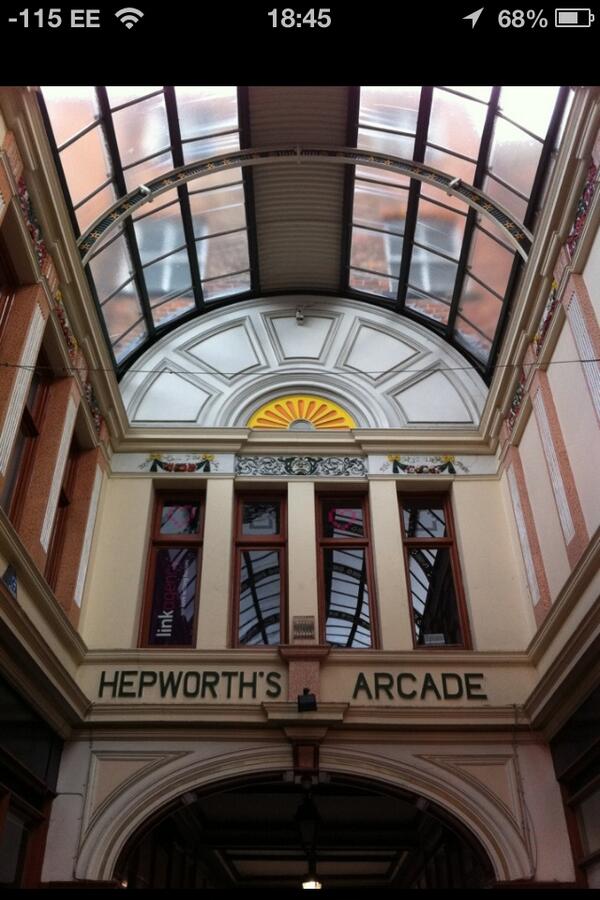
Thanks to Mark Healey for this Hepworths Arcade pic, taken on Saturday.

I came to Hull in 1972 to begin what would prove to be the most important years of my young life and future career. My time with the University's Drama and English departments wasn't a hasty syllabus of printed handouts and "reading weeks" but a real, eye-opening, immersive education in which the city itself played a seamless part. In the cinema club under the Central Library I had my first sight of the films of Andrei Tarkovsky, and shook the hand of Peter Cushing. Heard my first live Mahler at the Philharmonic. Chose a favourite picture at the Ferens Gallery (Alexander Slaying Cleitus, Daniel de Blieck - not for the action, but for the control of space). Hull Truck was a young theatre company laying the groundwork of a national reputation while Hull's touring venues played host to a range of guests and visitors, from the fledgling Actors' Company revival of a rare Chekov with Ian McKellen, to the awesome old-school stagecraft of Morecambe and Wise.I sense your curiosity about the choice of picture. I was actually looking online for a shot of Hepworth's Arcade on Silver Street, one of my favourite places in the city, when I came across this image of the Health Department's ace ratcatcher on the History Centre's website.
Hull was famous, then and now, for producing students who found it hard to tear themselves away. Though I left at the end of my time, I'm proud to maintain some links. I've life membership of the Friends of the Gulbenkian (the University's unique purpose-built teaching theatre). All my drafts and working papers go into the care of the Hull History Centre, a state-of-the-art archive at the forefront of international research into the challenges of long-term digital storage. Every year I swear I'll revisit the unforgettable fair, and someday I will.
Why City of Culture 2017? These have been hard decades for the creative life of every British town but in Hull there's a significant cultural infrastructure to be saved, preserved, restored and reinforced. I'm one of the many who have been equipped by the partnership of city and university to take that spirit forward. I'd like to see it continue through further generations; I can't imagine a better investment, or a finer legacy.
If I have to explain further, then we're probably both wasting our time.
UPDATE:
Thanks to Mark Healey for this Hepworths Arcade pic, taken on Saturday.
Tuesday, 27 August 2013
No You Don't
Movies about magicians are tricky.
OK, now we've got that out of the way, let me explain. One of my less satisfying viewing experiences of the summer was a heist movie called Now You See Me, the premise for which involved four illusionists teaming up and combining their skills to pull off a series of spectacular and ingenious crimes.
The spectacle was there but key moments of that ingenuity were achieved with VFX rather than performance skills. So where's the point? Magic, like dance, is one of those things that you appreciate because a human being is doing it.
In the early days of television, screen magicians understood that without a perception of honesty in the presentation, the person-to-person trickery has no value. So no cuts, no camera tricks. We expect to be fooled, but not cheated of any chance to spot how. In these less principled times, when exposed dishonesty has been rebranded as 'constructed reality' and no one admits disgrace, it's possible to see concocted TV magic where no magic is performed at all - a performer pretends to do a trick, a crowd of stooges pretends to be amazed, and the trick itself is faked in the edit. Check out online magic forums to see other magicians calling out the offenders.
But what does that matter in a movie? They're actors, not magicians, any more than Natalie Portman and Mila Kunis are ballerinas. And the actors do a creditable amount of work to convince us that they can do this stuff. Many of the story's illusions mimic famous effects, and magic advisor David Kwong was involved at the scripting stage:
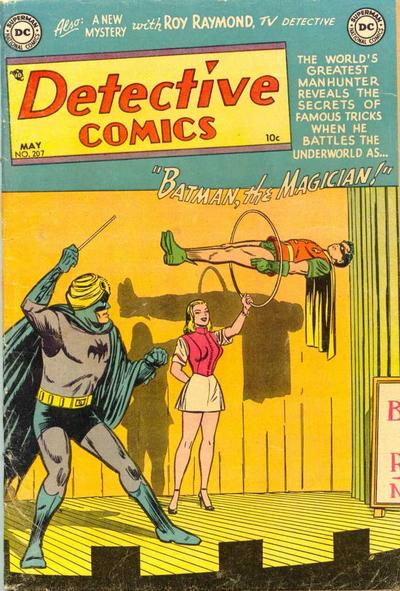
Now You See Me's problem is that the Trouble rarely convinces. So for now, I'll have to make do with this.

OK, now we've got that out of the way, let me explain. One of my less satisfying viewing experiences of the summer was a heist movie called Now You See Me, the premise for which involved four illusionists teaming up and combining their skills to pull off a series of spectacular and ingenious crimes.
The spectacle was there but key moments of that ingenuity were achieved with VFX rather than performance skills. So where's the point? Magic, like dance, is one of those things that you appreciate because a human being is doing it.
In the early days of television, screen magicians understood that without a perception of honesty in the presentation, the person-to-person trickery has no value. So no cuts, no camera tricks. We expect to be fooled, but not cheated of any chance to spot how. In these less principled times, when exposed dishonesty has been rebranded as 'constructed reality' and no one admits disgrace, it's possible to see concocted TV magic where no magic is performed at all - a performer pretends to do a trick, a crowd of stooges pretends to be amazed, and the trick itself is faked in the edit. Check out online magic forums to see other magicians calling out the offenders.
But what does that matter in a movie? They're actors, not magicians, any more than Natalie Portman and Mila Kunis are ballerinas. And the actors do a creditable amount of work to convince us that they can do this stuff. Many of the story's illusions mimic famous effects, and magic advisor David Kwong was involved at the scripting stage:
CGI was employed in hand doubling for more elaborate moves and one trick where Fisher’s character floats above the audience in a bubble. “They’re portrayed as the magicians of tomorrow,” he says. “The director asked me what tricks I wanted to do, but never quite had the method for them."That's where the film falls down, in director Louis Leterrier 's cavalier use of what's been placed at his disposal. There are tricks here that look like known tricks, but with a damaging sense of no method behind them. Behind all magic stands hard science. As Christopher Priest suggested in The Prestige, the most significant element in an illusion is the invisible work behind it, referred to as The Trouble. With its emphasis on planning, execution, and surprise, The Trouble is also a fair description of what makes a successful heist movie tick.
Now You See Me's problem is that the Trouble rarely convinces. So for now, I'll have to make do with this.
Wednesday, 21 August 2013
New Stories

On sale from August 24th is Thirteen, an audio anthology available for MP3 download with a CD version to follow. Thirteen is...
...presented as a portmanteau anthology, with an umbrella story tying all 13 stories together, and produced with appropriate sound effects to give the impression of an old vinyl recording - a homage to the horror LPs of the 60s and 70s.My story is titled With Her in Spirit and is read by Frances Barber.
Yeah, Frances Barber. How about that?
There's a full list of stories and performers at the Spokenworld Audio website. The other contributors include Kim Newman, Mark Morris, and Simon Clark, with readings by Arthur Darville, Gemma Arterton, Greg Wise, Lalla Ward... don't make me list 'em all, click on the link and take a look for yourself.
Then in November there'll be Twisted Histories, a paperback anthology from Snowbooks which includes my story Blame the French. More about that one nearer the date.

Monday, 5 August 2013
Who's Who
So we made it back from London just in time to catch the second half of the BBC's live announcement of the new Doctor Who casting, settling down before the TV with the Bargain Bucket we'd picked up on the way home. We hadn't been rushing back, or anything. Twitter was hardly likely to be silent on the subject in the coming hours. Not if the past few months have been anything to go by.
Given that I wasn't particularly invested, I was surprised to feel oddly moved when Capaldi stepped out. It was a nice moment and it felt right in all kinds of ways. I have no form when it comes to anticipating Who recastings; I'd never have predicted Smith, Tennant or Eccleston. Now I see them all as manifestly right moves... with the possible exception of Eccleston, who for me will always be the odd-man-out Doctor.
I'm not saying he didn't work. One of my favourite "Welsh Who" stories is an Eccleston episode, Rob Shearman's Dalek. But his leather-jacketed rough-edged Everyman seemed to stand outside the parameters of a character that, until that point, I'd imagined had none. A strength of the format, I'd always assumed, was that the Doctor could be anybody. But suddenly I could see a testing of the hidden limitations behind that illusion of infinite possibility.
With Tennant and then Smith we were back within the parameters, whatever they are. Don't ask me to define them; casting is an art, not a science. Nor is it an opportunity for social engineering; it's high-stakes showbusiness, with a massive commercial decision resting on a producer's shoulders. Moffat is not only tasked with making the decision, but with making the decision work.
Were I in the hot seat, I'd have cast Capaldi like a shot. He's been on my male-lead wishlist for almost every project of the last 20 years, and the fact that he's never appeared in anything of mine is a sign of the regard usually given to a writer's casting thoughts. I suppose it's ironic that he's now on the show when I'm not. But there you go.
And people complaining that he's too old; f*** you, he's younger than me.
Given that I wasn't particularly invested, I was surprised to feel oddly moved when Capaldi stepped out. It was a nice moment and it felt right in all kinds of ways. I have no form when it comes to anticipating Who recastings; I'd never have predicted Smith, Tennant or Eccleston. Now I see them all as manifestly right moves... with the possible exception of Eccleston, who for me will always be the odd-man-out Doctor.
I'm not saying he didn't work. One of my favourite "Welsh Who" stories is an Eccleston episode, Rob Shearman's Dalek. But his leather-jacketed rough-edged Everyman seemed to stand outside the parameters of a character that, until that point, I'd imagined had none. A strength of the format, I'd always assumed, was that the Doctor could be anybody. But suddenly I could see a testing of the hidden limitations behind that illusion of infinite possibility.
With Tennant and then Smith we were back within the parameters, whatever they are. Don't ask me to define them; casting is an art, not a science. Nor is it an opportunity for social engineering; it's high-stakes showbusiness, with a massive commercial decision resting on a producer's shoulders. Moffat is not only tasked with making the decision, but with making the decision work.
Were I in the hot seat, I'd have cast Capaldi like a shot. He's been on my male-lead wishlist for almost every project of the last 20 years, and the fact that he's never appeared in anything of mine is a sign of the regard usually given to a writer's casting thoughts. I suppose it's ironic that he's now on the show when I'm not. But there you go.
And people complaining that he's too old; f*** you, he's younger than me.
Subscribe to:
Posts (Atom)


 Posts
Posts


