"Gallagher’s detective is a man of fine character and strong principles, but he’s upstaged by the monsters he pursues. Watching Becker track down a pedophile is gratifying, but it can’t beat the sight of 20 overburdened boats hurtling through white-water rapids or Sir Owain, armed to the teeth and blasting away at giant serpents only he can see."The complete review here.
Wednesday, 29 February 2012
Stasio on Crime
The Bedlam Detective reviewed by Marilyn Stasio in The New York Times:


Tuesday, 28 February 2012
The Reprisalizer
 Anyone familiar with British 70s paperback series, and particularly those from the New English Library, will know exactly what's going on here.
 This spoof site is the brainchild of British comedy actor Matthew Holness, whose previous comic creation was horror writer Garth Marenghi, the "self-appointed mastermind author" and writer, producer and director of Garth Mareghi's Darkplace. Imagine if the UK's worst horror hack had been given the sets, cast, and budget of the cheapest 80s daytime soap, and you're probably there.
Holness's new creation is Bob Shuter, "suburban vigilante", riding a "red hot trail of vengeance through the urban hell of Thanet" in such titles as I, The Fury, Stock Car Slaughter, and Riot in Borstal Wing 'B', all supposedly the work of prolific and plainly demented wordsmith Terry Finch.
Apparently there's a Reprisalizer feature in development which plays a line between satire and dark psychology. It's expanded from Holness' 17-minute short A Gun for George.
Personally I'm torn between appreciation of the spoof, and feelings of genuine nostalgia.
Tuesday, 14 February 2012
The Kindness of Strangers
They don't sign the notices over at Kirkus Reviews so I don't know how better to describe this one...
UPDATE: The full review is now online and you can read it here.
"Gallagher has been called a horror writer, a fantasy writer, a non-fantasy writer, a writer for big screens and smaller ones, a writer whose considerable talent has enabled him to slip in and out of genres precisely as if those tidy little boxes didn't exist - as indeed they don't for his character-driven books. In this one, Sebastian Becker (The Kingdom of Bones, 2007, etc.), his fast-track career abruptly derailed, contemplates an uncertain future...[snip]
...Gallagher loves character development but respects plotting enough to give it full measure. The result is that rare beast, a literary page-turner."
UPDATE: The full review is now online and you can read it here.
Sunday, 12 February 2012
Savage Season Interview
From an interview just posted on the Savage Season Books website:
(Actually, it's mostly "me, me, me")
And while we're at it, internet, there is no such thing as a "sneak peak".
"I’ve never consciously scheduled my career to the extent that I could say, Oh, yeah, I put this aside and focused on that. If you do this for a living then you’re relentlessly pushing to do all you can all the time in whatever medium. And when you feel a bit of give, see a chink of light, sense the opportunity to get something off your wish list and out into the world, then you pour all of your energies into that."See me sort out the future of publishing, the impact of the eBook, selling your stuff to America, the role of the small press, and everything short of World Peace here.
(Actually, it's mostly "me, me, me")
And while we're at it, internet, there is no such thing as a "sneak peak".
Saturday, 11 February 2012
I got piles
Barnes & Noble, 53rd and 3rd, New York

With thanks to Stephanie.
You can order from B&N online here, where they're also selling the eBook for the Nook and taking pre-orders for the audio version.
With thanks to Stephanie.
You can order from B&N online here, where they're also selling the eBook for the Nook and taking pre-orders for the audio version.
Thursday, 26 January 2012
Murder Rooms: The Ultimate Collection
 If you were planning to order this DVD set, hold off; there's a problem with it.
 Instead of the promised widescreen remastering, the discs contain stretched and distorted 'fullscreen' images of very poor quality.
Even at 4:3 the transfer is pretty awful. My set's going back, pronto.
I've emailed the distributor and I'll pass on whatever I find out.
UPDATE:
It's not looking good. The distributor seems to think that the quality's acceptable and calls it a 'multi-aspect ratio transfer' - which means that it's a 4:3 that'll distort itself to fit whatever TV screen you show it on.
Disappointing, perplexing... I have to say, don't touch it. It looks awful.
Sunday, 15 January 2012
The Movies, Mr Fairbanks, and Me
 Looking back, 1977 was a key year for me. I didn't rocket to fame, I didn't take British culture by storm - though I'm sure those were the dreams I was having at the time. What I did in '77 was to stage a play with a local amateur company (a talented bunch who deserved better material, if I'm honest), sell my first radio drama, and see my first book in print (a novelisation of said radio piece).
With all that going on, I thought I was the bee's nuts. I imagined I could do anything. In retrospect I was no shooting star, and in retrospect I'm grateful for that. I was getting the thing I didn't know I wanted; grounding for a sustainable career based in diversity. I've seen writers of my generation have a hit and disappear, or spend the rest of their careers struggling to match it, or be stuck repeating themselves until death offers a release.
For me, a different pattern emerged. I'd have a great year, then a shit year, then I'd reinvent the wheel. It's as bumpy as the Indiana Jones ride at Disneyland, and fun in the same rough hazards-and-surprises kind of way.
In '77, I was going to write a musical. It was going to be about Doug Fairbanks and Mary Pickford, about the glory of silent cinema and the birth of superstardom, about the formation of United Artists and the end of an era with the coming of sound.
I know with the success of The Artist it's trendy to say so, but I've always loved silent film. From before the Thames Silents presentations, before Michael Bentine's Golden Silents on the BBC, all the way back at least to Bob Monkhouse's Mad Movies, intelligently presented from his own collection. The only Oscar I've ever held was Robert Youngson's, for The Days of Thrills and Laughter. Monkhouse was the real deal as a collector but I once had a modest collection of my own, starting in childhood with a 50' clip of Chaplin's Easy Street that came with a second-hand tinplate projector from Shawcross's of Eccles, local auction house and Aladdin's Cave.
 As a teen I'd wash cars and blow my savings on Super 8 prints of the classics; my first and most-wanted was Metropolis, my most-watched were the Fairbanks costume spectaculars - Robin Hood, The Mark of Zorro, The Black Pirate - every one of them a veritable foundation document for a different action genre. The Blackhawk catalogue, Thunderbird Films, Perrys of Wimbledon, Derann of Dudley - these were the dealers of my dreams.
I had special affection for Blackhawk's The Thief of Bagdad, which I'd run with the accompanying piano improv soundtrack by Florence de Jong and Ena Baga. The music was recorded during a screening at the Academy One cinema, and issued on vinyl. I was going to add "issued on vinyl for geeks like me" but I was a dabbler, really, compared to some. I've an awful suspicion that my love for any subject is determined by the extent to which I can steal from it.
So in '77, heady with a droplet of success and firm in the delusion that I could tackle anything under the sun, I set my sights on Doug and Mary.
He was Hollywood's biggest male star, and she was "America's Sweetheart". Fairbanks was a graceful athlete of spontaneous creative instincts combined with great determination, while Pickford was as clearsighted in business as she was vulnerable onscreen. Their romance was genuine, their partnership golden, its ending a sad disengagement. There was a shape there; the key would be to find a theme.
In the late 70s Doug's only son, Douglas Fairbanks Jr, was living in London's Mayfair. It has to be tough following in the footsteps of such an iconic father but Douglas Jr had made his own mark, first with (in his words) "big roles in little pictures, and little roles in big pictures" and then, following distinguished war service, some big roles in big pictures and an active role in early international TV production. With all the confidence of an upstart, I wrote to him.
(By which I mean I wrote him a proper letter, not its modern, mass-emailed, hey-you-you're-famous-so-help-me-out equivalent.)
He wrote back, generously and at length, and more than once.
13th June, 1977.The hair rises slightly on the back of my neck as I read the reference to "my step-mother" - Mary Pickford was still living at the time, and stayed with us until the end of the decade.
Dear Mr Gallagher
Thank you very much for your courtesy in writing and I am proud and delighted that you would want to write something about my father’s career.However, I do want to warn you that the idea had already occurred to two or three other people over the past fifteen or twenty years, and even though they have been well-known playwrights and theatre people the projects have come to nothing because, except for a couple of domestic problems, my father's life per se was not sufficently dramatic to justify a play. His career was indeed spectacular and he was unquestionably a great creative artist and producer but beyond that the material is not rich enough to sustain a complete play. Any detailing of domestic sidelights would be likely to lead to complications as some of the people are still living - such as my step-mother.
I have no personal objection to your trying to write such a play but I thought it only fair to warn you that others had come to a dead end working on the same idea. There have been two recent books about my father which I would recommend to your attention: “DOUGLAS FAIRBANKS, THE FIRST CELEBRITY” and "THE FAIRBANKS ALBUM", both by Richard Schickel. These are both well researched and accurate and make interesting reading but I do think they would be difficult to dramatize. The most theatrical part of my father’s life was on the screen rather than off.
Yours sincerely
Douglas Fairbanks

As it happened I'd read the first of the Schickel books under its American title of His Picture in the Papers. I didn't keep copies of my own end of the correspondence, so I can't say what impression I was making. But I must have communicated at least some of my enthusiasm.
I mean, just look at this.
23rd June, 1977.Toward the end of the year Fairbanks went to Australia, touring his stage production of The Pleasure of His Company, but he took the trouble to have his assistant update me with his New York address for correspondence after the tour.
Dear Mr Gallagher,
I was most interested in your kind and informative reply to my letter and I will be most interested to follow your progress in your intended dramatization.
I must however invite your attention the fact that the "decline" of the careers of certain film artists after 1930 was due to a number of different reasons - unique to each individual - and not because of the problem of the market no longer providing the suitable outlet you refer to.
In the case of D. W. Griffith, for example, his own decline as a director began several years before that and had really nothing to do with either the advent of sound or the changes in corporate interests. It was merely that this very great talent had burnt itself out and his films, even in the middle 20s when he continued to have a free hand and satisfactory budgets, no longer enjoyed either public or critical support. The situation, despite everyone's goodwill, became too expensive and risky to go along with and no one appreciated this fact more than Griffith himself. Consequently the other partners of United Artists covered for him as best they could and he eventually retired from that association.
Keaton on the other hand was quite another "cup of tea” in so far as he had never really been completely his own master in terms of production and distribution. He was recognized within the profession as being one of the most gifted and original of all comedians but he was never too interested in business per se. Even when his silent films had begun to slump and he associated himself with Joseph Schenck (as a result of his marrying the sister of Norma Talmadge, who was then Mrs Schenck) in order that the burden of production would not fall on him, this did not work out. The introduction of sound films may have made some difference in the end, but it was not really the main problem, which was somewhat like that of Griffith in so far as the public no longer supported him in the way that they once had, and his prestige and drawing power- even at its height - could not compete with Chaplin's. It is only now in retrospect that we realize that he was actually in many ways Chaplin's equal as a mime, but it was not as fully appreciated then as it is now.
The case of my father and Chaplin was something else again. It was not that their careers "declined" because of the need to "reshape their careers" nor to the introduction of corporate interests entering the field. It was largely due to the fact that both Chaplin and my father had believed that their best medium was the purely pictorial or visual form of story-telling and that they did not really want to introduce or participate in sound films themselves. When they did so it was due almost entirely to their obligations to the company they had formed together, and they took relatively little interest and had little enthusiasm for what they did so long as they were meeting their responsibilities as partners. They had no objection to sound films made by others, and in fact enjoyed them immensely, but they did not really want to even try for themselves. Both Chaplin and my father had hoped to avoid the responsibility of making more films unless they were silent but could not do so and had to alter the original concept of United Artists and bring in others who would supply enough production to maintain the overhead costs of their distribution organizations. It was less them but more my stepmother, Mary Pickford, who actually went out and sought others to join United Artists - such as Joseph Schenck (mentioned above), who also later brought in Daryll Zanuck and later Samuel Goldwyn. But the short answer is that they were all professionally "tired" and preferred to let the original United Artists concept be altered, and hence gradually pulled out of production altogether. There was no real drive or wish to continue their careers as such because in fact they had none of them suffered any very severe reverses. They just lost interest and evolved a plan to expand their corporation so that they could "slide out" of their obligations and let others "carry the ball". Miss Pickford was the only one who really wanted to continue and so the various changes that took place over the next ten or more years at United Artists were usually opposed by her and she was the last one to sell out her shares. I know very well that my father could have - had he wanted to - continued to produce films of the same quality and of the same standard as before, but he quite openly admitted that he no longer had any desire or wish to.
The proof of my statement lies in the way he practically "cheated" in the making of his last few films. "Round the World in 80 Minutes" came about only as a result of putting together his films of a world tour he made - originally intended for a private record and later, when he realized that he must deliver something, he added some linking sequences on his return and put it out as if it had been planned that way from the first. Mr. Robinson Crusoe was never “planned” but came about as a result of a yachting cruise he made with some companions in the Pacific and, when they arrived in Tahiti and again he faced pressures from his partners and the distribution organization repeated its demands, he decided to use the cruise as the basis for a film. It was made in a relatively haphazard way and as a result of a snap decision to do something. Once again, additional scenes were made later upon his return and he was glad to be done with it. “Reaching for the Moon" and "Don Juan" commanded so little interest and enthusiasm from him and he was so wrapped up with other matters in his private life that he, for the first time since his first year in films, delegated practically all of the responsibility for production to others, managing thereby to divest himself of the chores he once enjoyed and to honour the agreement with his partners with the least trouble to himself.
In other words, what I am trying to suggest is that in these latter cases it was not that their careers declined for the reasons you suggest but because they had run out of ideas, used up their energies and really did not wish to adapt themselves to changes in the medium. They were delighted when new partners were brought in and they could sit back and let others carry the load that they had originally carried.
I trust the above will be of some interest and use to you as it is in fact a matter of record as to what happened.
The last letter I have came from the Town House in Adelaide in the November of that year. I'd been telling him of some of the material that his advice had led me to, and he wrote:
I was most interested to read of the progress you have made wading through all that very dated and often unreliable material... X’s book is, as you suggest, a very good one in many ways and indeed it is one of the best although even here I have found numerous errors, some trivial and some serious. It is so awfully hard to be certain about anything concerned with such a self-disguising industry as the Motion Picture Industry.It pretty much ended there because he'd been right from the beginning; despite my fascination with the subject, in the end I couldn't crack it.
With the best of wishes.
I am,
Sincerely,
DOUGLAS FAIRBANKS JNR.
But what a gentleman. I can only hope I showed an adequate appreciation of his kindness.
Saturday, 14 January 2012
And so to Bedlam
No, I don't plan to quote every review I get - not least because it's asking for trouble and an inevitable eventual slap from someone somewhere - but thanks to Pamela O'Sullivan for making my weekend with this contribution to The Library Journal.
Gallagher, Stephen. The Bedlam Detective. Crown Pub. Group. Feb. 2012. c.320p. ISBN 9780307406644. $25.
Reviews: Fiction | First Look at New Books, January 13, 2012
Sebastian Becker is a special investigator for the Lord Chancellor’s Visitor in Lunacy — a detective who studies whether various wealthy individuals are of sound mind and capable of conducting their own affairs. He is assigned to investigate a rich landowner, but his arrival in the man’s small town coincides with a double murder for which the subject of his visit seems a likely suspect. As he works to ferret out the truth, Becker must find a way to distinguish the real monsters from the imaginary ones. The story moves easily between present and past events, leading to a conclusion that is as perfectly logical as it is surprising.
Verdict Intricately drawn characters, carefully shaded depictions of events and situations, and an excellent sense of pacing mark this latest offering from Gallagher (The Kingdom of Bones; Nightmare, with Angel). This is a real page-turner, and fans will hope to see more of Sebastian Becker in the future. It may also attract readers who enjoy historical thrillers in the Caleb Carr tradition.
Thursday, 5 January 2012
Back to the Murder Rooms (2)
My daughter Ellen, known to the Twitterverse as @audreydeuxpink, had a small speaking part in my Murder Rooms episode and has been blogging about her experience of the shoot. Check out the middle picture in the post below - that's her in the doorway of the travelling-show caravan, between Warwick Davies and Charles Edwards.
You can read the first instalment here.
You can read the first instalment here.
Tuesday, 3 January 2012
Back to the Murder Rooms
Is it Box Set or Boxed Set? One's wrong but sounds right, the other's right but... oh, never mind.The main thing is that the series of TV-feature length Murder Rooms mysteries produced by BBC Films is finally getting a widescreen DVD release in the UK. Created by David Pirie out of a two-hour special that he'd made a couple of years before, the series features the young Arthur Conan Doyle (Charles Edwards) and his real-life mentor Dr Joseph Bell (Ian Richardson) in what amounted to a new and baggage-free take on the Watson-Holmes relationship. The set comes bundled with a 2002 Holmes documentary fronted by Patrick Macnee.
I imagine that the commercial thinking behind the release involves a gamble on the continuing Richie/Downey/Moffatt/Gatiss movie and TV euphoria... the individual shows have been around on DVD for a while but in a form I've always recommended avoiding. They were soft, muddy 'fullscreen' transfers, released when the 4:3 format was already on its last legs. The target market seemed to be technophobes and pensioners; the discs could be had for a fiver in Past Times shops and at one point were even given away with The Daily Express. The episodes were actually gorgeously lit and shot on crisp Super-16. They'd look great in Hi-Def or on Blu-Ray. I know 'cos I was there.
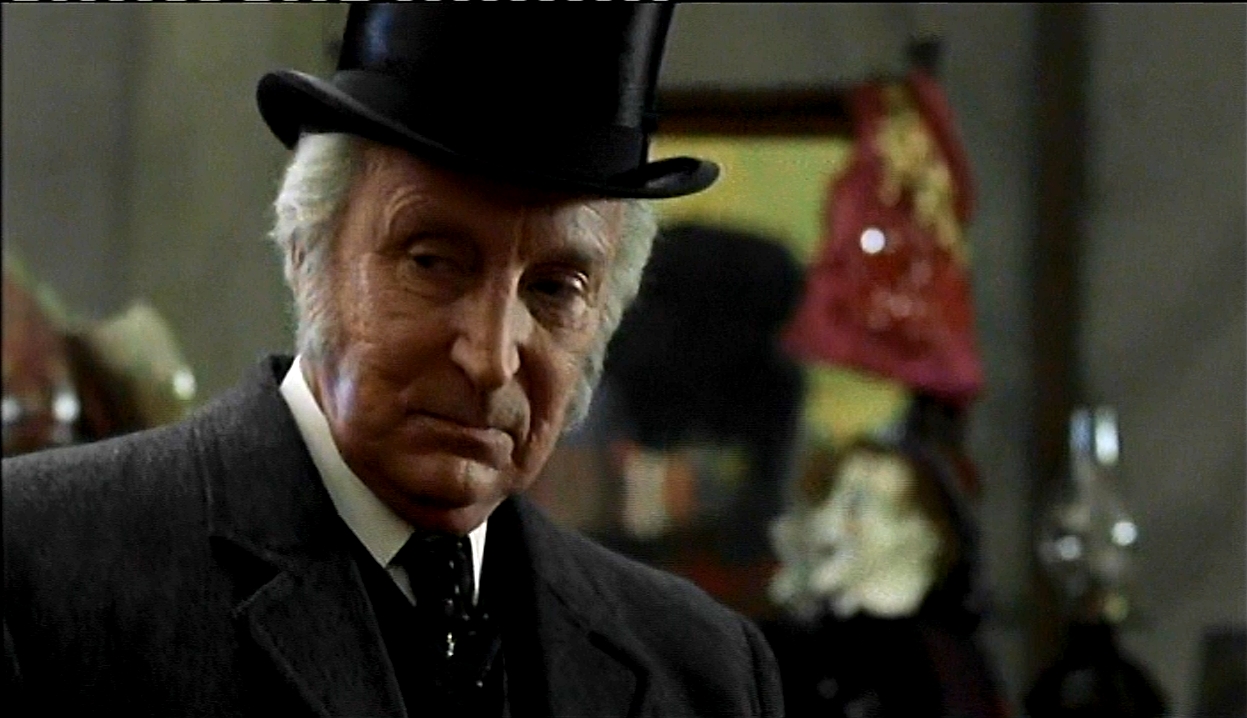
Let's leap lightly over the fact that my Murder Rooms story and one of my (unrelated) novels share a title - I can explain how that happened some other time. But I loved the show, thought it showed the BBC at its best and had a driving concept that would have sustained it for a number of seasons.
I almost didn't get to join the party. The BBC Films machinery was set up to deal with one-offs, not series, and funding was being released in stop-start increments. First the money for one script, then for another... then a green light to go ahead with the first couple of episodes... it was like the constant opening and shutting of a miser's purse, a few coins reluctantly handed over every time. The original aim was, I believe, to film seven stories. I think mine was fifth in line but it got bumped up in the production order because I got my first draft in quickly, and with most of what it needed already in place. The purse slammed shut on four episodes but by then I was in.
It was a class production, handsomely done. The series producer was Alison Jackson, with Jamie Laurenson as development exec/script editor. My director was Simon Langton - Simon effing Smiley's-People Pride-and-Prejudice Langton. I watched and learned. He shot with graceful, understated, old-school brilliance - terms that could equally describe Ian Richardson's approach to an old-school magisterial role. The editor came on set one day to observe, and confided to me that he wanted to see how it was being done because the footage was pretty much falling together.

And it was a success - the notices were good, and so were the viewing figures. We geared up for second season that would kick off with those three unmade stories. I was asked for another, and put in my pitch. Ian Richardson shared his Joseph Bell research with me. David Pirie got a publishing deal.
The BBC pulled the plug. All plans were cancelled.
I was told some time after the event that this was most likely the outcome of a silent turf war between BBC Drama and BBC Films. The word went around that the show had been "too successful for the wrong department". Co-producers The Television Company offered to take it over and finance it themselves, but were turned down. BBC Drama then announced a Hound of the Baskervilles with Australian actor Richard Roxburgh for screening the following year. My recall is that it was a serviceable retread of the familiar material, but nothing special. A disappointing changeling, for many.

The new set won't be out for a couple of weeks yet, so I can't comment on its quality. Ignore the information on the Amazon sleeve pictures, they're for the old versions; in an email this morning, a representative for distributors IMC told me, "I can confirm the new set with the four episodes will be in a 16:9 re-edited format." Prior to this, if you wanted to get hold of widescreen DVDs you'd have to order from Sweden, the US, or Australia.
Personally, I'd like to see them reshown on the BBC's HD channel. Not least because I might get a couple of bob out of it. But mainly for, you know, cultural reasons.
UPDATE: The 'Ultimate Collection' DVD set is unwatchable. Avoid.
Tuesday, 27 December 2011
Everyone's a Critic
 Okay, first up, here's the deal; the eBook versions of both Down River and Oktober are relaunching with new covers by Paul Drummond, and I've 20 review copies of each to give away. In return I ask you to add your review to the Oktober and Down River pages on Amazon.com. Use the contact page to let me know if you're up for it.
How you rate them and what you write is entirely up to you. I'm not shilling for stars, just hoping to see some balance in the system; I can't fathom how Amazon aggregates its marketing material but there's some weird alchemy that sometimes pulls in the reviews from previous editions, sometimes not. In this case I've got two otherwise well-received novels, one of which spawned a TV miniseries, in new editions with their two worst notices attached.
Well... their two worst notices so far.
I guess I'm old-school in that I think you should draw the line at asking friends to give you favourable reviews or, even worse, writing your own. During the research period for Crusoe, I chased down various Defoe biographies; the worst-organised and least useful of them carried a glowing five stars from its own author, writing about himself in the third person.
But the eBook jungle favours the barefaced; one self-published writer's strategy involved organising a squad of friends and family to buy multiple copies of his book within the same hour, with a simultaneous order for one of the site's topselling titles. The aim was to ride the 'customers who bought this item also bought...' algorithm to public attention.
Did it work? I've no idea.
Until four or five years ago, the writing game was fairly clear-cut. You wrote your first book and when it got turned down you wrote another. Here's how that works: your writing evolves as you go, and you realise that as you look back. It's not about that one book, but about developing your skills. Eventually you plunder your early work and it sees the light of day in a form you hadn't originally imagined.
There was one debutant I knew who'd written an 800-page SF epic and was determined that he wouldn't write another word until the world had recognised the work he'd put in. It wasn't a bad first book but it wasn't special, either. I urged him to write short stories and submit them to small presses as a way to build up his writing skills and connect with an audience, but it wasn't what he wanted to hear.
Last I heard, he was very bitter and had still written nothing else. But how would I advise him now? The handful of stories of debut authors who self-publish and do well, beating the odds like lottery winners, provide ammunition to counter any argument for a learning process. Especially when it's a painful learning process that used to be involuntary, but which can now be sidestepped.
Some of them may be terrific writers. The few that I've looked at aren't, but they do fall into an honourable tradition of fast fiction, offered cheap, that runs from the feuilletons of the nineteenth century through the story papers, pulps, and mushroom jungle paperbacks of the twentieth.
Just like those 'mushroom publishers' of the postwar period, created in an explosion of low-cost bulk fiction occasioned by the lifting of paper rationing, the vendors of eBooks are more concerned with turnover than quality. They're exploiting an opportunity, and doing so to the hilt. But I'd like to think that, as with those same postwar publishers, e-publishing's business moves may eventually enrich the field without destroying it. Darcy Glinto may well be unreadable now, but it's a grim culture that has no room for Lady - Don't Turn Over.
My most-retweeted Twitter remark of recent weeks is Still befuddled by ppl who drop serious money on an eReader but won't pay more than 99c for a book. Clearly it chimed with a shared perception that a generation of buyers are being trained to expect all books to be dirt-cheap or given away. But after reading this blog post by Romance writer Elle Lothlorian, I brightened a little. She writes:
While skimming various Kindle reader forums, I ran across a thread on the topic of pricing. One reader wrote that she never bought a book that was $2.99 or less because it was sure to be self-published “indie crap” riddled with typos... (by setting a low price) I think I had inadvertently turned my Amazon page into the equivalent of a dubious used-car lot, with blinking neon lights screaming “SALE, SALE SALE! EVERYTHING MUST GO!”The thrust of the piece is that by raising her prices, she engaged with a more committed and interested readership. Her sales actually went up, suggesting that there are still readers who are interested in something other than a race to the bottom in quality and price. They're out there; they've always been out there; it's just that there's a 'fair field full of folk' obscuring them from our view.
I don't control the eBook price of The Kingdom of Bones or The Bedlam Detective, but while I don't plan on putting my backlist titles in the premium bracket, I'm not about to throw them in the bargain bin either.
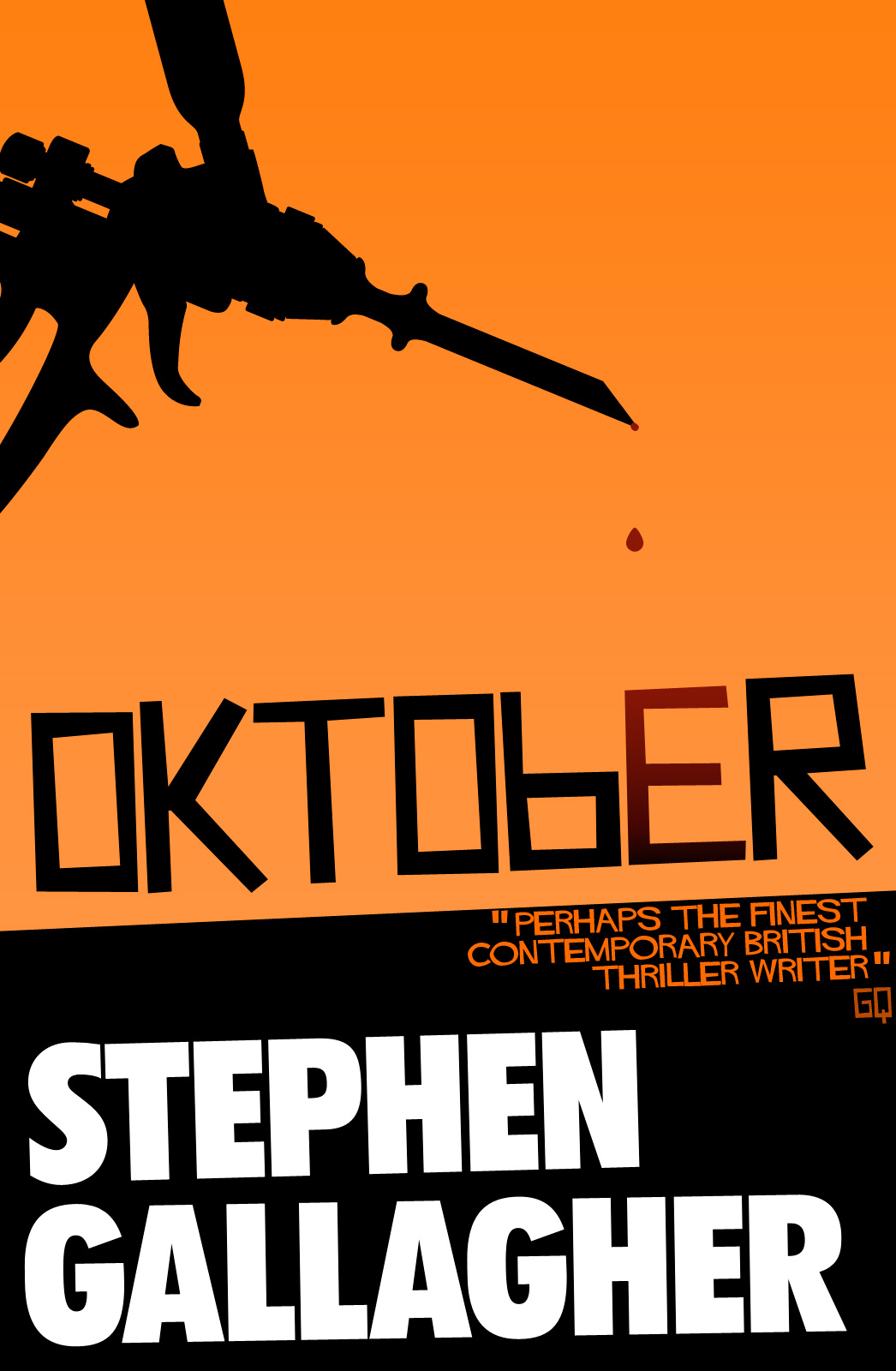
Link for review copies here.
Friday, 16 December 2011
Bernice Summerfield Did My Headshots
Seriously. Lisa Bowerman - aka Doctor Who's Bernice Summerfield - is a talented portrait photographer, specialising in actors' headshots. You'll find numerous examples of her work in the Spotlight directory of performers. She works with traditional film negative and natural light, moving to digital for delivery.

Photo credit: Lisa Bowerman
Okay, so Pitt and Clooney have nothing to worry about. But I love the way she takes honest shots with no flattery or fakery. And technically she's so good that you can zoom in to my eyeball at the highest resolution and see her with the camera reflected there.
For actors it's important to show who you are, not what skilful studio lighting could make you look like fifteen years ago. Having been on the other side of the audition table to hear actors read, I can say that sending in a misleading photo does no one any good at all. Rather than give you a head start, it suggests insecurity and, at worst, delusion.
Writers' headshots are a whole other field of study.
We need to have them but, being writers, we don't want to pay for them. Sometimes your publisher will commission some publicity stills but that doesn't always work out - Hodder & Stoughton once sent me to a man who specialised in photographing fruit for Marks & Spencer. Maybe they chose him because of the "&". I don't know what fruit he had in mind when he studied me - maybe Zombie Cucumber. We took the shots in his attic, with me lurking behind a wormy pillar or looking out around a peeling chimney wall. The result: I looked like a ghoul in the fourth stage of something terminal.
I fared no better when I decided to splash out on some shots of my own. I picked a local wedding photographer with a sideline in industrial work - he should have been good, he had a studio and everything. I asked for no diffusion but he thought he knew better. The results were well nigh unusable - not sharp enough for good reproduction and I looked like one of those primped 80s guys in Movies4Men softcore porn.
Don't tell me you don't know what I'm talking about.
My first professional headshot was for the jacket of Valley of Lights. I forget who put me onto him, but the photographer was Arthur Waite of Arthur Waite Publicity, a one-man operation in a poky studio behind Salford Cathedral just down the road from Granada TV. Arthur looked a little bit like Paul Daniels, as I recall... there was an electric fire warming the studio and a Sheltie lying on a dog bed in the corner. Arthur specialised in photographing Variety acts and advertising copy for The Stage. His portfolio included Ken Dodd, Tom O'Connor, and International Cabaret Stars Margo and Trevor.
I told him what I did and what I needed. He'd never had a writer for a client before. He thought it over then gave me the lighting he used for magicians, which I rather liked the idea of. I liked the work he did, as well.

Photo credit: Arthur Waite Publicity
Hey. I've not changed that much. Maybe I could get away with using this one...

Photo credit: Lisa Bowerman
Okay, so Pitt and Clooney have nothing to worry about. But I love the way she takes honest shots with no flattery or fakery. And technically she's so good that you can zoom in to my eyeball at the highest resolution and see her with the camera reflected there.
For actors it's important to show who you are, not what skilful studio lighting could make you look like fifteen years ago. Having been on the other side of the audition table to hear actors read, I can say that sending in a misleading photo does no one any good at all. Rather than give you a head start, it suggests insecurity and, at worst, delusion.
Writers' headshots are a whole other field of study.
We need to have them but, being writers, we don't want to pay for them. Sometimes your publisher will commission some publicity stills but that doesn't always work out - Hodder & Stoughton once sent me to a man who specialised in photographing fruit for Marks & Spencer. Maybe they chose him because of the "&". I don't know what fruit he had in mind when he studied me - maybe Zombie Cucumber. We took the shots in his attic, with me lurking behind a wormy pillar or looking out around a peeling chimney wall. The result: I looked like a ghoul in the fourth stage of something terminal.
I fared no better when I decided to splash out on some shots of my own. I picked a local wedding photographer with a sideline in industrial work - he should have been good, he had a studio and everything. I asked for no diffusion but he thought he knew better. The results were well nigh unusable - not sharp enough for good reproduction and I looked like one of those primped 80s guys in Movies4Men softcore porn.
Don't tell me you don't know what I'm talking about.
My first professional headshot was for the jacket of Valley of Lights. I forget who put me onto him, but the photographer was Arthur Waite of Arthur Waite Publicity, a one-man operation in a poky studio behind Salford Cathedral just down the road from Granada TV. Arthur looked a little bit like Paul Daniels, as I recall... there was an electric fire warming the studio and a Sheltie lying on a dog bed in the corner. Arthur specialised in photographing Variety acts and advertising copy for The Stage. His portfolio included Ken Dodd, Tom O'Connor, and International Cabaret Stars Margo and Trevor.
I told him what I did and what I needed. He'd never had a writer for a client before. He thought it over then gave me the lighting he used for magicians, which I rather liked the idea of. I liked the work he did, as well.

Photo credit: Arthur Waite Publicity
Hey. I've not changed that much. Maybe I could get away with using this one...
Subscribe to:
Posts (Atom)


 Posts
Posts


